In today’s fast-paced business environment, organizations that leverage real-time risk dashboards and analytics gain a competitive edge by making informed decisions faster than ever before.

🚀 The Evolution of Risk Management in the Digital Age
Risk management has transformed dramatically over the past decade. Gone are the days when businesses relied solely on quarterly reports and retrospective analysis to understand their risk exposure. Modern organizations now demand instant visibility into potential threats, vulnerabilities, and opportunities that could impact their operations.
The shift toward real-time monitoring represents more than just a technological upgrade—it’s a fundamental change in how companies approach strategic planning and operational resilience. Traditional risk assessment methods often left businesses vulnerable to emerging threats that developed between reporting periods. Real-time dashboards eliminate this blind spot by providing continuous monitoring and immediate alerts when risk parameters change.
This transformation has been driven by several factors: the increasing complexity of global business operations, the rapid pace of market changes, heightened regulatory requirements, and the availability of advanced analytics technologies. Organizations that fail to adopt real-time risk monitoring find themselves at a significant disadvantage, reacting to problems rather than preventing them.
📊 Understanding Real-Time Risk Dashboards
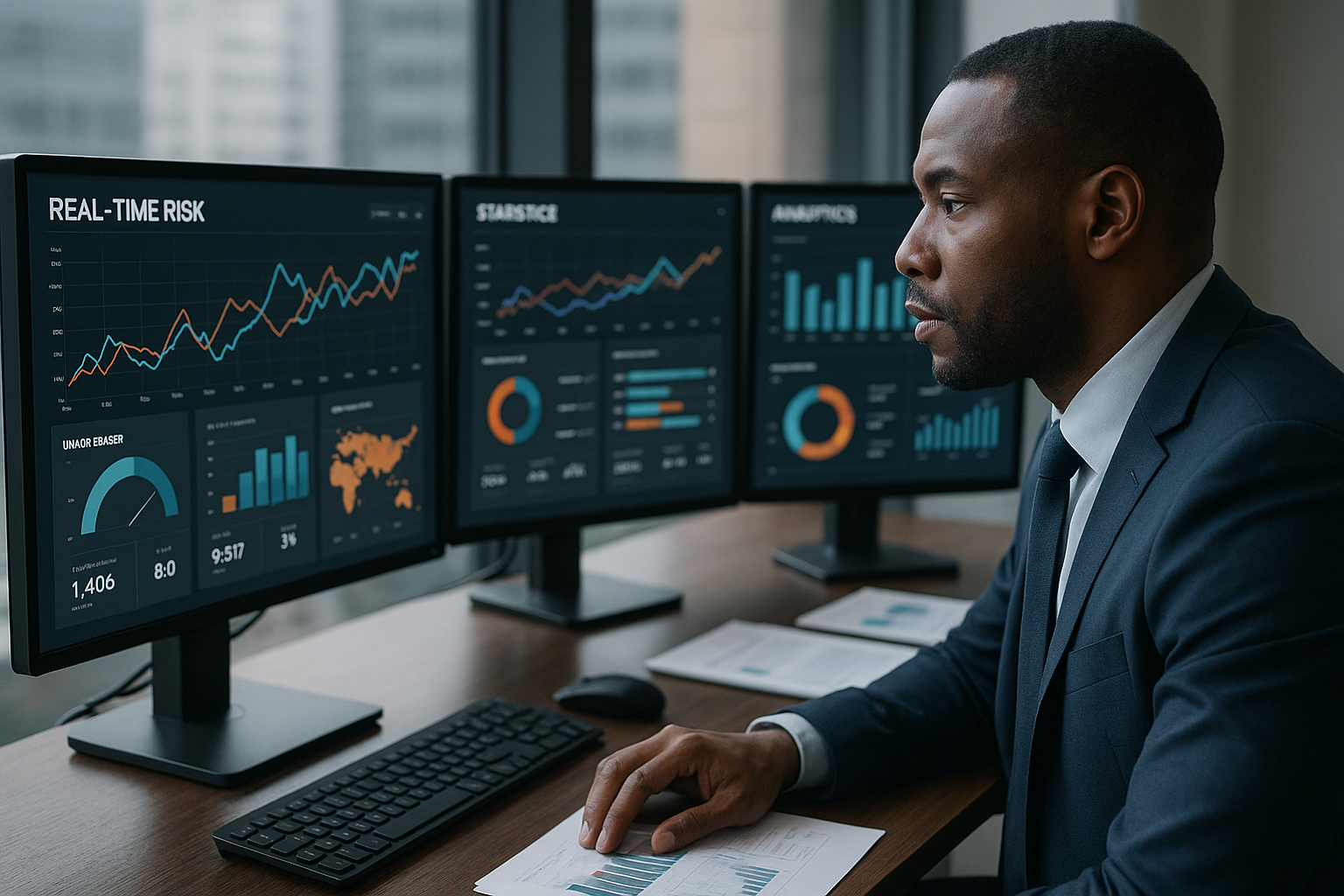
Real-time risk dashboards serve as command centers for modern risk management. These sophisticated platforms aggregate data from multiple sources, process it instantly, and present actionable insights through intuitive visual interfaces. Unlike static reports, these dashboards update continuously, reflecting the current state of an organization’s risk landscape.
The core functionality of these systems includes data integration from disparate sources such as financial systems, operational databases, market feeds, social media channels, and external threat intelligence platforms. This comprehensive data collection enables a holistic view of organizational risk that was previously impossible to achieve.
Key Components of Effective Risk Dashboards
A well-designed risk dashboard incorporates several essential elements. Visual analytics transform complex data sets into easily digestible charts, graphs, and heat maps that highlight critical information at a glance. Customizable views allow different stakeholders—from board members to operational managers—to access relevant information tailored to their specific needs and responsibilities.
Alert mechanisms represent another crucial component, automatically notifying designated personnel when risk metrics exceed predetermined thresholds. These notifications ensure that decision-makers can respond immediately to emerging situations rather than discovering problems through routine reviews.
Predictive analytics capabilities leverage historical data and machine learning algorithms to forecast potential future risks before they materialize. This forward-looking approach enables proactive risk mitigation rather than reactive damage control.
💡 How Analytics Drive Smarter Decision-Making
The true power of real-time risk dashboards lies not in the data they display but in the decisions they enable. Advanced analytics transform raw information into strategic intelligence that guides executive choices, operational adjustments, and resource allocation.
Pattern recognition algorithms identify trends and correlations that human analysts might miss, uncovering hidden relationships between seemingly unrelated factors. This capability proves especially valuable in complex environments where multiple variables interact in non-obvious ways.
From Data to Action: The Decision-Making Pipeline
Modern analytics platforms follow a structured process that begins with data collection and culminates in actionable recommendations. The system continuously ingests information from all connected sources, applies cleaning and normalization procedures to ensure data quality, and then subjects this refined data to various analytical models.
Statistical analysis identifies anomalies and deviations from expected patterns. Machine learning models assess the significance of these variations and predict potential outcomes based on historical precedents. Natural language processing can even analyze unstructured data sources like news articles, social media posts, and customer feedback to identify emerging reputational or operational risks.
The final stage translates these analytical findings into clear, prioritized recommendations. Rather than overwhelming decision-makers with raw data, sophisticated systems present concise summaries of key risks, their potential impact, the likelihood of occurrence, and suggested mitigation strategies.
🎯 Industry-Specific Applications
Different sectors leverage real-time risk analytics in ways tailored to their unique challenges and regulatory environments. Understanding these industry-specific applications demonstrates the versatility and necessity of modern risk management platforms.
Financial Services and Banking
Financial institutions face an exceptionally complex risk landscape encompassing credit risk, market volatility, liquidity concerns, operational failures, and cybersecurity threats. Real-time dashboards monitor trading positions, loan portfolios, transaction patterns, and regulatory compliance metrics simultaneously.
Banks use these systems to detect fraudulent transactions as they occur, identify customers at risk of default before payments are missed, and ensure adequate capital reserves against potential losses. Regulatory reporting, which once consumed enormous resources, becomes largely automated as dashboards maintain continuous compliance monitoring.
Healthcare Organizations
Healthcare providers utilize risk dashboards to monitor patient safety indicators, infection rates, medication errors, staffing adequacy, and financial performance. These systems alert administrators to potential issues like unusual readmission patterns or supply chain disruptions that could compromise patient care.
The COVID-19 pandemic highlighted the critical importance of real-time health risk monitoring, as hospitals needed instant visibility into bed capacity, equipment availability, staff exposure levels, and infection trends to make life-or-death resource allocation decisions.
Manufacturing and Supply Chain
Manufacturers employ risk analytics to monitor equipment performance, quality metrics, supply chain disruptions, and workforce safety. Predictive maintenance algorithms analyze sensor data from machinery to forecast failures before they occur, preventing costly downtime and production delays.
Supply chain dashboards track vendor performance, logistics delays, inventory levels, and geopolitical events that might disrupt material flows. This comprehensive visibility enables rapid response to disruptions and more resilient supply chain design.
🔒 Cybersecurity and Threat Intelligence Integration
Cyber threats represent one of the fastest-evolving risk categories, making real-time monitoring absolutely essential. Modern risk dashboards integrate cybersecurity intelligence to provide unified visibility across traditional business risks and digital threats.
These integrated platforms correlate security events with business impact, helping organizations understand not just that an attack is occurring but what specific business functions, data assets, or customer relationships are at risk. This contextualization enables more effective prioritization and response.
Threat intelligence feeds provide information about emerging attack vectors, vulnerabilities in commonly used software, and indicators of compromise associated with known threat actors. When combined with internal security monitoring, these external intelligence sources create a comprehensive picture of an organization’s cyber risk posture.
📈 Implementation Strategies for Maximum Impact
Successfully deploying real-time risk dashboards requires more than purchasing software. Organizations must approach implementation strategically to ensure adoption, accuracy, and actionable insights.
Start with Clear Objectives
Define what specific decisions the dashboard should support and which risks pose the greatest threats to organizational objectives. Attempting to monitor everything simultaneously often results in information overload and analysis paralysis. Prioritize the most critical risk categories and expand coverage gradually.
Ensure Data Quality and Integration
Risk analytics are only as good as the underlying data. Invest in data governance practices that ensure accuracy, completeness, and timeliness. Establish clear ownership for each data source and implement validation procedures that catch errors before they contaminate analytical outputs.
Integration challenges often represent the biggest implementation obstacle. Legacy systems may not easily connect with modern analytics platforms, requiring middleware solutions or custom API development. Plan for these technical challenges during the project scoping phase.
Design for Your Audience
Different stakeholders need different views. Executives require high-level summaries with drill-down capabilities, while operational managers need detailed metrics relevant to their specific domains. Risk specialists may want access to underlying data and analytical models for validation and refinement.
User interface design significantly impacts adoption rates. Dashboards should be intuitive enough that users can extract needed information without extensive training, yet sophisticated enough to provide deep analytical capabilities when required.
🌐 The Role of Artificial Intelligence and Machine Learning
Artificial intelligence represents the next frontier in risk analytics, enabling capabilities that far exceed traditional statistical approaches. Machine learning algorithms can process vastly more data points than human analysts, identify subtle patterns across complex datasets, and continuously improve their predictive accuracy.
Natural language processing allows systems to analyze unstructured text from news sources, regulatory filings, customer communications, and internal documents. Sentiment analysis can detect early warning signs of reputational risk by tracking how an organization is discussed across social media and news platforms.
Computer vision techniques enable risk assessment from visual data sources, such as analyzing satellite imagery to assess supply chain disruption risks from natural disasters or monitoring manufacturing facilities for safety compliance through automated video analysis.
Ethical Considerations in AI-Driven Risk Management
While AI offers tremendous capabilities, organizations must carefully consider ethical implications. Algorithmic bias can perpetuate or amplify existing inequities if training data reflects historical discrimination. Transparency in how AI systems make risk assessments becomes crucial for maintaining stakeholder trust and meeting regulatory requirements.
Human oversight remains essential. AI should augment rather than replace human judgment, particularly for decisions with significant ethical dimensions or when dealing with novel situations outside the training data’s scope.
⚡ Real-Time Response and Automated Risk Mitigation
The logical extension of real-time risk monitoring is automated response. Advanced systems don’t just alert humans to problems—they can execute predetermined mitigation actions instantly when specific conditions are met.
Financial trading platforms automatically close positions when losses exceed defined thresholds. Cybersecurity systems isolate compromised network segments before attacks can spread. Supply chain platforms automatically reroute shipments when primary logistics routes become unavailable.
These automated responses dramatically reduce the time between risk detection and mitigation, often preventing minor issues from escalating into major crises. However, automation must be implemented carefully with appropriate safeguards, override capabilities, and continuous monitoring to ensure automated actions produce intended results.
🔄 Measuring Dashboard Effectiveness and ROI
Demonstrating the value of risk dashboard investments requires establishing clear performance metrics. Organizations should track both direct financial impacts and indirect benefits that contribute to organizational resilience.
Direct financial benefits include losses prevented through early detection, reduced insurance premiums from demonstrable risk management improvements, and decreased regulatory penalties through enhanced compliance monitoring. Operational efficiency gains from automated reporting and reduced manual data compilation also generate measurable savings.
Indirect benefits, while harder to quantify, often provide even greater value. Improved decision quality leads to better strategic outcomes. Enhanced risk culture throughout the organization creates more proactive risk awareness. Stakeholder confidence increases when leadership demonstrates sophisticated risk management capabilities.
🌟 Building a Risk-Aware Organizational Culture
Technology alone cannot transform organizational risk management. Real-time dashboards achieve maximum impact when embedded within a culture that values proactive risk awareness and data-driven decision-making.
Leadership must model appropriate dashboard usage, regularly reviewing risk metrics during strategic discussions and basing significant decisions on analytical insights rather than intuition alone. This top-down emphasis signals throughout the organization that risk management represents a core competency rather than a compliance obligation.
Training programs should ensure employees at all levels understand how to interpret dashboard information relevant to their roles and responsibilities. Risk management becomes more effective when everyone from front-line workers to senior executives shares a common understanding of organizational priorities and early warning indicators.
🚦 Future Trends in Risk Analytics
The field of risk analytics continues evolving rapidly. Several emerging trends will shape the next generation of risk management capabilities.
Cloud-based platforms are democratizing access to sophisticated analytics previously available only to large enterprises. Smaller organizations can now leverage enterprise-grade risk monitoring without massive infrastructure investments.
Internet of Things devices generate unprecedented volumes of operational data that feed into risk models. Sensors monitoring everything from equipment vibration to environmental conditions provide early warning of potential failures or hazardous situations.
Quantum computing, while still in early stages, promises to revolutionize risk modeling by enabling simulation of vastly more complex scenarios than current systems can handle. This capability will particularly benefit organizations dealing with highly interdependent risk factors.
Blockchain technology offers potential for more transparent and verifiable risk data, particularly in supply chain applications where multiple parties need to share information while maintaining data integrity.
💼 Competitive Advantage Through Superior Risk Intelligence
Organizations that master real-time risk analytics gain competitive advantages that extend far beyond avoiding losses. Superior risk intelligence enables more aggressive pursuit of opportunities because leaders understand the true risk-reward tradeoffs.
Companies can enter new markets with greater confidence when dashboards provide continuous monitoring of market conditions, regulatory environments, and competitive dynamics. Product development cycles accelerate when teams quickly identify and mitigate technical or market risks that might derail launches.
Investor relations benefit from demonstrable risk management sophistication. Organizations that present comprehensive risk dashboards during investor presentations signal operational maturity and strategic foresight that enhance valuation and reduce capital costs.
The ability to make faster, better-informed decisions ultimately determines success in dynamic business environments. Real-time risk dashboards and analytics transform decision-making from reactive to proactive, from intuition-based to evidence-driven, and from siloed to integrated across the entire enterprise.
Organizations that embrace these capabilities position themselves not just to survive but to thrive amid uncertainty, turning potential threats into opportunities and establishing sustainable competitive advantages that compound over time. The question is no longer whether to implement real-time risk analytics but how quickly you can deploy these capabilities before competitors gain an insurmountable advantage.