Natural disasters strike without warning, leaving devastation in their wake. But what if technology could help us see the storm before it arrives? 🌪️

The integration of predictive analytics into disaster management has fundamentally transformed how communities prepare for, respond to, and recover from catastrophic events. From hurricanes barreling toward coastal cities to wildfires spreading across dry forests, advanced data analysis now provides critical insights that save lives and protect infrastructure. This technological revolution represents one of the most significant advances in emergency management, combining artificial intelligence, big data, and sophisticated modeling techniques to forecast disasters with unprecedented accuracy.
🔍 The Foundation of Predictive Analytics in Disaster Management
Predictive analytics leverages historical data, real-time information streams, and complex algorithms to forecast future events with remarkable precision. In the context of natural disasters, this means analyzing patterns from past events, monitoring current environmental conditions, and identifying subtle indicators that precede catastrophic occurrences.
Traditional disaster response operated on a reactive basis—communities scrambled to evacuate and mobilize resources only after threats became imminent. This approach left little time for strategic planning and often resulted in chaotic evacuations, insufficient resource allocation, and preventable casualties. Predictive analytics shifts this paradigm from reactive to proactive, providing emergency managers with the temporal advantage they desperately need.
The technology aggregates data from diverse sources including weather satellites, seismic sensors, ocean buoys, social media feeds, and historical disaster databases. Machine learning algorithms process this information to identify patterns invisible to human analysts, detecting correlations between seemingly unrelated variables that signal impending danger.
🌊 Forecasting the Unforeseen: Types of Disasters Being Predicted
Different disaster types require unique predictive approaches, each with distinct data requirements and analytical methodologies. Understanding these variations helps appreciate the complexity and sophistication of modern disaster forecasting systems.
Hurricane and Tropical Storm Prediction
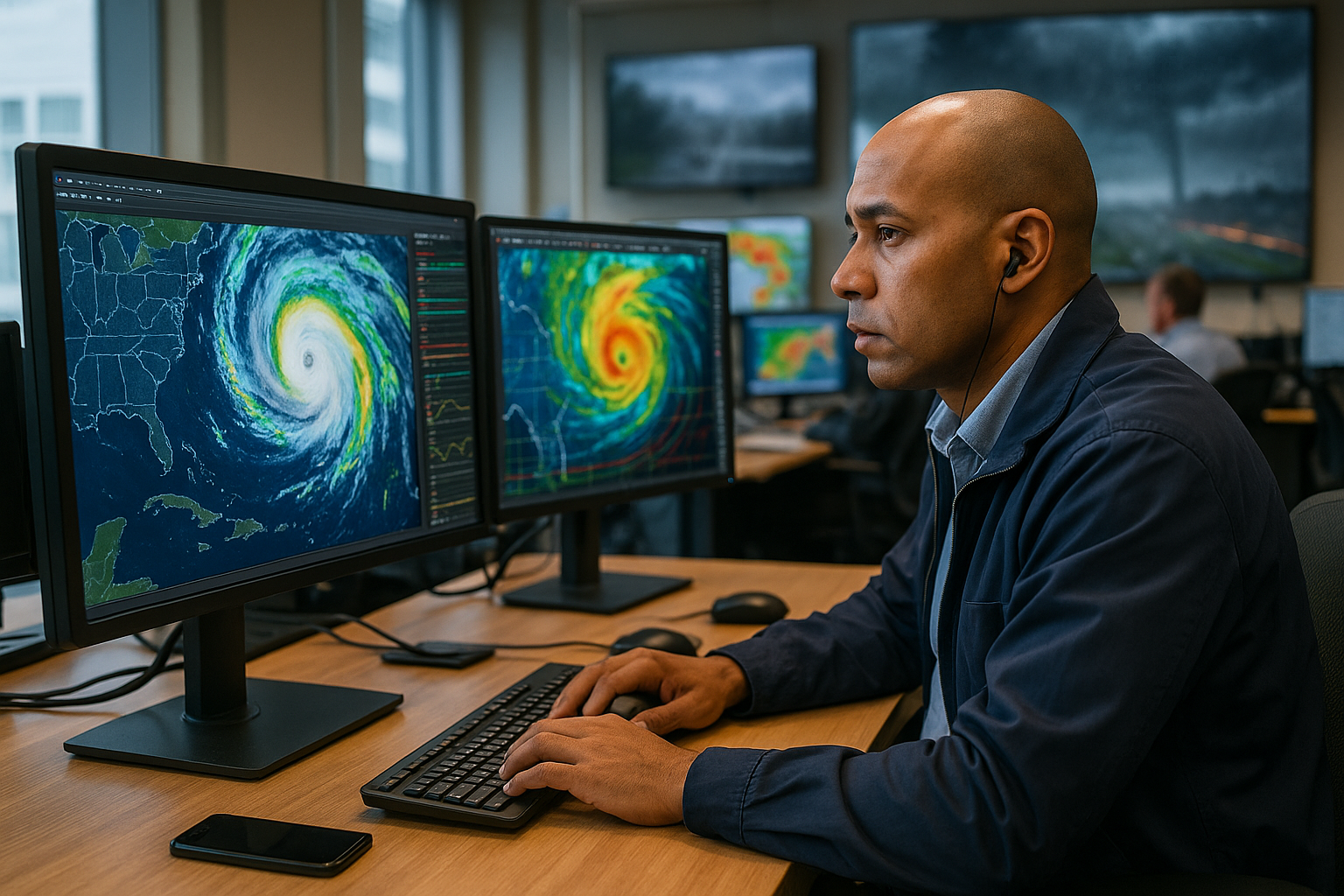
Hurricane forecasting has achieved remarkable accuracy improvements over recent decades. Advanced atmospheric models now analyze ocean temperatures, wind patterns, barometric pressure systems, and historical storm behaviors to predict hurricane paths and intensities days in advance. These models can estimate potential storm surge heights, rainfall accumulation, and wind speeds with precision that enables targeted evacuations rather than blanket orders affecting entire regions.
Modern hurricane prediction incorporates ensemble forecasting, which runs multiple simulation models simultaneously to account for uncertainty. This approach provides probability cones showing likely storm paths and confidence intervals for intensity predictions, giving emergency managers nuanced information for decision-making.
Wildfire Risk Assessment
Wildfires present unique challenges because they involve complex interactions between weather, vegetation, topography, and human activity. Predictive analytics for wildfire management combines satellite imagery showing vegetation dryness, meteorological forecasts of temperature and wind, topographical data, and historical fire behavior patterns.
Advanced systems can identify high-risk areas weeks before fire season begins, allowing preventive measures like controlled burns and vegetation management. During active fire events, real-time prediction models forecast fire spread patterns, helping firefighters position resources strategically and plan evacuation routes.
Earthquake Early Warning Systems
While earthquakes remain fundamentally unpredictable in terms of long-range forecasting, seismic sensor networks can detect initial earthquake waves and predict the arrival and intensity of damaging secondary waves. Though the warning window is measured in seconds or minutes rather than days, this brief advance notice enables automated responses like shutting down gas lines, stopping trains, and alerting populations through smartphone notifications.
Predictive analytics also identifies areas with elevated seismic risk based on geological surveys, helping communities prioritize building code enforcement and infrastructure reinforcement in vulnerable zones.
Flood Forecasting and Management
Flood prediction combines hydrological modeling, weather forecasting, and geographic information systems. These systems monitor rainfall patterns, snowmelt rates, river levels, and soil saturation to predict flooding events with increasing lead times. Advanced models account for urban drainage capacity, dam operations, and tidal influences in coastal areas.
The integration of real-time sensor data with historical flood patterns enables precise prediction of which neighborhoods will flood, to what depth, and when inundation will occur. This granular information transforms evacuation planning and emergency response coordination.
💡 The Technology Stack Powering Disaster Prediction
The effectiveness of predictive analytics in disaster response depends on sophisticated technological infrastructure that collects, processes, and disseminates information at scale.
Internet of Things (IoT) Sensors
Vast networks of connected sensors form the eyes and ears of modern disaster prediction systems. Weather stations, stream gauges, seismometers, air quality monitors, and specialized sensors continuously collect environmental data. These IoT devices transmit information in real-time, creating comprehensive situational awareness that feeds analytical models.
Satellite Technology and Remote Sensing
Earth observation satellites provide critical data that ground-based sensors cannot capture. Thermal imaging reveals drought conditions and fire hotspots, while radar satellites penetrate cloud cover to monitor storms and track flooding. Satellite data enables monitoring of remote and inaccessible areas, ensuring comprehensive coverage regardless of terrain or infrastructure limitations.
Artificial Intelligence and Machine Learning
Machine learning algorithms excel at identifying complex patterns within massive datasets. Neural networks trained on decades of disaster data can recognize subtle precursor signals that human analysts might miss. These AI systems continuously improve their accuracy as they process new events, learning from both successful predictions and unexpected outcomes.
Deep learning models can analyze satellite imagery to assess building damage after disasters, prioritize search and rescue operations, and estimate recovery timelines. Natural language processing algorithms mine social media feeds to identify emerging crisis situations and gauge public sentiment during emergencies.
Cloud Computing Infrastructure
The computational demands of predictive disaster analytics require scalable cloud infrastructure. Cloud platforms provide the processing power necessary to run complex simulations and the storage capacity to maintain extensive historical databases. Cloud-based systems also ensure redundancy, maintaining operational capability even when local infrastructure fails during disasters.
📱 Real-World Applications Saving Lives Today
The theoretical promise of predictive analytics translates into concrete applications that are already protecting communities worldwide.
Early Warning Systems and Public Alerting
Smartphone-based emergency alert systems leverage predictive analytics to deliver targeted warnings to populations in harm’s way. These systems can send location-specific alerts about approaching tornados, flash floods, or wildfires, providing actionable information and evacuation guidance directly to affected individuals.
Resource Pre-Positioning and Supply Chain Management
Emergency management agencies use predictive models to pre-position supplies, personnel, and equipment before disasters strike. By forecasting likely impact areas and estimating resource requirements, agencies can station ambulances, water supplies, generators, and rescue teams strategically, dramatically reducing response times when disaster strikes.
Private sector companies also leverage these predictions to protect supply chains, rerouting shipments around predicted disaster zones and accelerating deliveries of critical supplies to likely impact areas.
Infrastructure Protection and Automated Responses
Critical infrastructure increasingly incorporates automated protection systems triggered by predictive analytics. Power grids can automatically shed loads or disconnect vulnerable segments when extreme weather approaches. Water utilities can lower reservoir levels ahead of predicted heavy rainfall to increase flood storage capacity. Transportation systems can halt operations or reroute traffic based on predicted hazard timelines.
Insurance Risk Assessment and Pricing
The insurance industry extensively employs predictive analytics to assess disaster risk, price policies appropriately, and manage exposure. These same analytical tools help insurers accelerate claims processing after disasters by predicting likely damage patterns and identifying areas requiring immediate attention.
🚧 Challenges and Limitations in Predictive Disaster Analytics
Despite remarkable advances, predictive analytics for disaster response faces significant challenges that constrain its effectiveness and reliability.
Data Quality and Availability Issues
Predictive models are only as good as the data feeding them. Many regions lack adequate sensor networks, creating blind spots in global monitoring systems. Historical data may be incomplete, inconsistent, or recorded using incompatible methodologies, complicating pattern recognition. Developing nations often have limited infrastructure for data collection, leaving vulnerable populations without adequate early warning systems.
Model Uncertainty and False Alarms
All predictive models involve uncertainty, and disaster forecasting frequently produces false alarms. Evacuating populations based on predictions that don’t materialize erodes public trust and compliance with future warnings. Balancing sensitivity and specificity—detecting genuine threats while minimizing false positives—remains an ongoing challenge.
The consequences of missed predictions can be catastrophic, creating pressure to err on the side of caution. However, excessive warnings desensitize populations and create economic disruption, highlighting the delicate equilibrium predictive systems must maintain.
Climate Change and Non-Stationarity
Climate change fundamentally alters disaster patterns, creating conditions without historical precedent. Predictive models trained on past data may fail when confronted with novel weather patterns, unprecedented temperature extremes, or disasters occurring in previously unaffected regions. The assumption that future patterns will resemble the past—a foundational principle in statistical modeling—breaks down in rapidly changing climatic conditions.
Computational Limitations and Processing Constraints
High-resolution disaster models require enormous computational resources, creating trade-offs between prediction accuracy and timeliness. Simulating atmospheric dynamics at fine spatial scales consumes processing time, potentially delaying warnings when speed is critical. Emergency situations demand rapid predictions, sometimes forcing reliance on less accurate but faster models.
🌐 Global Initiatives and Collaborative Frameworks
Recognizing that disasters transcend borders, international organizations coordinate efforts to build global predictive analytics capabilities.
The United Nations Office for Disaster Risk Reduction promotes standardized approaches to disaster prediction and early warning systems. International data sharing agreements enable countries to pool observations, enhancing model accuracy for everyone. The World Meteorological Organization coordinates global weather observation networks, ensuring consistent, high-quality meteorological data collection worldwide.
Regional cooperation initiatives address disasters affecting multiple countries, such as transboundary river flooding or regional hurricane systems. These collaborative frameworks establish communication protocols, standardize terminology, and coordinate cross-border evacuations and resource sharing.
Open-source predictive modeling platforms democratize access to sophisticated analytical tools, enabling resource-constrained communities to implement disaster prediction systems without prohibitive development costs. These collaborative development efforts accelerate innovation and ensure that technological advances benefit vulnerable populations most at risk.
🔮 The Future Landscape of Disaster Prediction
Emerging technologies promise to further revolutionize disaster prediction and response, pushing the boundaries of what’s possible in protecting communities from natural hazards.
Quantum Computing Applications
Quantum computers could dramatically accelerate complex disaster simulations, enabling real-time high-resolution forecasts that current systems cannot achieve. These systems might process probabilistic scenarios simultaneously, providing emergency managers with comprehensive risk assessments across multiple potential disaster trajectories.
Enhanced Satellite Constellations
New satellite networks featuring smaller, more numerous spacecraft will provide unprecedented temporal and spatial resolution for Earth observation. Near-continuous monitoring will capture rapid environmental changes that current systems miss, improving prediction of fast-developing hazards like flash floods and rapidly intensifying storms.
Integration of Social and Behavioral Data
Future predictive systems will increasingly incorporate human behavior patterns, recognizing that disaster impacts depend not only on physical hazards but also on how populations respond. Understanding evacuation compliance rates, communication patterns during emergencies, and community resilience factors will enable more accurate impact predictions and more effective warning strategies.
Personalized Risk Communication
Advances in data analytics will enable hyper-personalized disaster warnings tailored to individual circumstances, locations, and vulnerabilities. Rather than broad-area alerts, people might receive specific guidance based on their exact location, mobility capabilities, and household composition, maximizing protective action effectiveness.
🎯 Building Resilient Communities Through Predictive Intelligence
The ultimate goal of predictive analytics extends beyond merely forecasting disasters—it’s about building community resilience that transforms how societies withstand and recover from catastrophic events.
Predictive insights inform long-term planning decisions about where communities should grow, how buildings should be constructed, and what infrastructure investments offer the greatest risk reduction. By identifying areas facing elevated future disaster risk, predictive analytics guides zoning decisions, building code development, and infrastructure design standards.
Education campaigns leverage predictive data to raise awareness about specific local risks, helping residents understand their vulnerabilities and prepare accordingly. When communities understand the hazards they face and trust the warning systems designed to protect them, compliance with evacuation orders increases and disaster outcomes improve.
Economic development strategies increasingly incorporate disaster risk assessments derived from predictive analytics. Businesses make location decisions based on predicted flood risks, hurricane exposure, and wildfire probability. This risk-informed development reduces economic vulnerability and prevents concentrating valuable assets in high-hazard areas.
⚡ Transforming Emergency Management Culture
Perhaps the most profound impact of predictive analytics is its transformation of emergency management culture from reactive crisis response to proactive risk management.
Emergency managers now operate as risk analysts and strategic planners rather than simply crisis responders. This shift elevates the profession, attracting talented data scientists and analytical experts into disaster management roles. The availability of predictive tools empowers local officials to make evidence-based decisions, reducing reliance on intuition and experience alone.
Accountability frameworks increasingly incorporate predictive information, with post-disaster reviews examining whether available forecasts were appropriately utilized. This accountability drives continuous improvement in how organizations translate predictions into protective actions.
The democratization of predictive tools enables smaller communities and developing nations to access capabilities previously available only to wealthy countries with extensive technical infrastructure. Cloud-based platforms and open-source models reduce barriers to entry, promoting global equity in disaster preparedness.
🌟 Embracing the Predictive Revolution
The revolution in predictive analytics for natural disaster response represents a fundamental paradigm shift in humanity’s relationship with natural hazards. While we cannot prevent earthquakes, hurricanes, or wildfires, we can increasingly anticipate them, prepare for them, and minimize their destructive impacts.
Success requires sustained investment in data collection infrastructure, continued algorithm development, and most importantly, effective translation of technical predictions into actionable protective measures. The technology exists—the challenge lies in ensuring predictions reach vulnerable populations in forms they understand and trust, motivating appropriate protective actions.
As climate change intensifies disaster frequency and severity, predictive analytics becomes not just advantageous but essential for community survival and resilience. The communities that embrace these tools, invest in the necessary infrastructure, and build cultures of preparedness will weather coming storms far better than those clinging to outdated reactive approaches.
The future of disaster response is predictive, proactive, and increasingly precise. By staying ahead of the storm through advanced analytics, humanity gains precious time—time to evacuate, time to prepare, time to protect what matters most. In disaster management, time saves lives, and predictive analytics delivers that most valuable commodity when it’s needed most. 🛡️