
Augmented reality is transforming how warehouses train their workforce, creating immersive learning experiences that dramatically improve operational efficiency and workplace safety standards.

🚀 The Digital Transformation of Warehouse Training
Traditional warehouse training methods are rapidly becoming obsolete in today’s fast-paced logistics environment. Paper manuals, shadowing exercises, and classroom lectures simply cannot keep pace with the complexity of modern warehouse operations. Augmented reality (AR) technology emerges as a game-changing solution, bridging the gap between theoretical knowledge and practical application in ways previously unimaginable.
The warehouse industry faces mounting pressure to reduce training time while simultaneously improving competency levels. With employee turnover rates averaging 36% annually in logistics sectors, companies cannot afford lengthy onboarding processes that take weeks or months. AR training platforms address this challenge by accelerating learning curves and ensuring consistent training quality across all locations.
Modern warehouses are increasingly automated, featuring complex machinery, robotics, and sophisticated inventory management systems. Workers must quickly master these technologies while maintaining high safety standards. Augmented reality creates a risk-free environment where employees can practice operating equipment, navigating layouts, and responding to emergencies without real-world consequences.
📱 Understanding Augmented Reality in Warehouse Environments
Augmented reality overlays digital information onto the physical world, creating an enhanced view of reality through smart glasses, tablets, or mobile devices. Unlike virtual reality, which creates entirely artificial environments, AR maintains connection with the real workspace while adding contextual information, instructions, and visual cues.
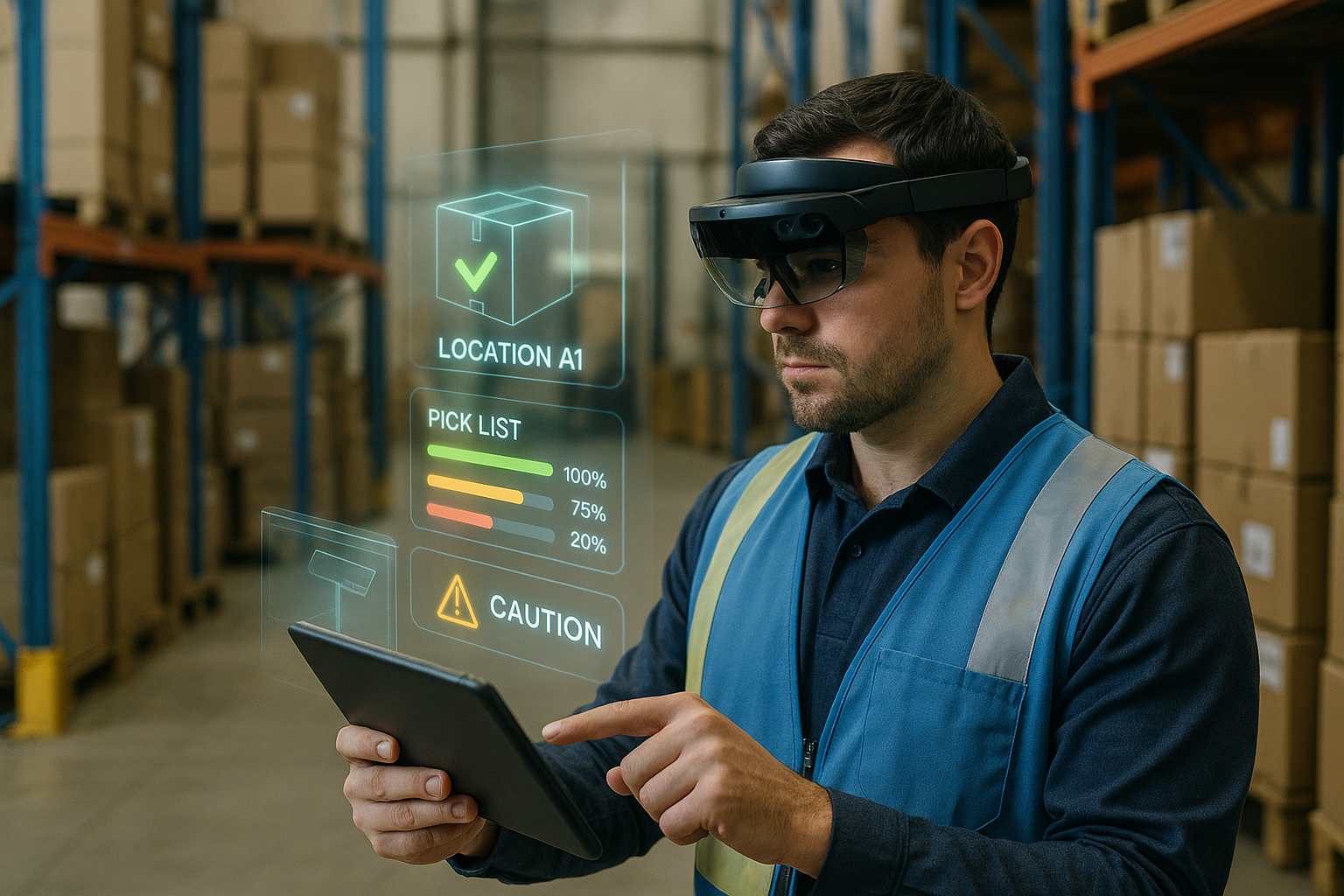
In warehouse settings, AR technology delivers real-time guidance directly within an employee’s field of vision. A warehouse picker wearing AR glasses might see highlighted shelving locations, product information, and optimal picking routes superimposed on their actual surroundings. This seamless integration of digital and physical worlds eliminates the need to constantly reference handheld devices or printed materials.
Key Components of AR Training Systems
Effective augmented reality training platforms incorporate several essential elements that work together to create comprehensive learning experiences:
- Hardware devices: Smart glasses, tablets, or smartphone-based AR viewers that display augmented content
- Tracking technology: Sensors and cameras that map physical spaces and recognize objects
- Content management systems: Platforms for creating, updating, and deploying training modules
- Analytics dashboards: Tools for monitoring trainee progress and identifying improvement areas
- Integration capabilities: Connections with existing warehouse management systems and databases
⚡ Boosting Operational Efficiency Through Immersive Learning
The efficiency gains from AR-based training extend far beyond the initial learning phase. Studies demonstrate that workers trained with augmented reality complete tasks 25-40% faster than those trained through conventional methods. This improvement stems from several interconnected factors that fundamentally change how knowledge is acquired and retained.
AR training eliminates the disconnect between classroom instruction and floor operations. Instead of trying to remember abstract concepts or recall steps from a manual, employees learn by doing in their actual work environment. This contextual learning approach creates stronger neural pathways, resulting in better retention and faster skill development.
Reducing Time-to-Competency
New warehouse employees typically require 4-6 weeks to reach basic competency levels using traditional training approaches. Augmented reality compresses this timeline significantly, with many organizations reporting 50% reductions in training duration. Trainees achieve proficiency faster because they receive immediate feedback and can repeat exercises without consuming valuable supervisor time.
The self-paced nature of AR training accommodates different learning speeds without holding back quick learners or rushing those who need extra practice. Each employee progresses according to their individual capabilities, ensuring genuine competency rather than merely completing a fixed training schedule.
Minimizing Operational Disruptions
Traditional training often disrupts normal warehouse operations, requiring dedicated equipment, space, and experienced personnel. AR training modules can run during off-peak hours or in designated areas without interfering with ongoing operations. Trainees practice on virtual representations of equipment, preventing bottlenecks caused by training activities monopolizing critical resources.
When operational changes occur—new equipment installations, layout modifications, or process updates—AR training content updates instantly across all devices. This agility eliminates the lag time associated with revising printed materials or scheduling new training sessions, ensuring workers always have access to current procedures.
🛡️ Elevating Safety Standards Through Risk-Free Practice
Warehouse environments present numerous safety hazards, from forklift operations to heavy equipment handling and hazardous material management. The Occupational Safety and Health Administration reports that warehouses experience injury rates significantly higher than general industry averages. Augmented reality training directly addresses this challenge by allowing unlimited practice with dangerous scenarios in completely safe conditions.
AR simulations replicate emergency situations—equipment malfunctions, fires, chemical spills, or structural failures—that would be impossible to practice safely in real life. Trainees develop muscle memory and decision-making skills for crisis situations without exposure to actual danger. This preparedness translates to calmer, more effective responses when genuine emergencies occur.
Forklift and Heavy Equipment Training
Operating forklifts and other powered industrial vehicles requires significant skill and poses substantial risks. AR training systems simulate various equipment types, load configurations, and operating conditions. Trainees navigate virtual obstacles, practice load balancing, and experience the consequences of improper technique—all without risking injury or equipment damage.
The technology tracks operator behavior, identifying unsafe practices like excessive speed, improper turning, or inadequate load securing. Immediate corrective feedback helps trainees develop safe habits before they ever operate actual equipment, dramatically reducing accident rates among newly certified operators.
Hazard Recognition and Response
Augmented reality excels at training workers to identify potential hazards before they cause incidents. AR applications can overlay safety information onto physical spaces, highlighting slip hazards, overhead dangers, or areas requiring personal protective equipment. This visual reinforcement develops hazard awareness that becomes second nature over time.
Emergency evacuation procedures become intuitive when practiced through AR simulations that adapt to different scenarios. Workers experience various emergency types and learn optimal escape routes from different warehouse locations, building confidence and competence that could save lives during actual emergencies.
💡 Real-World Implementation Success Stories
Major logistics companies and warehouse operators worldwide have already embraced augmented reality training with measurable results. These early adopters provide valuable insights into implementation strategies, challenges overcome, and tangible benefits realized.
DHL implemented AR-based vision picking systems in several warehouses, achieving 25% efficiency improvements while reducing error rates to near zero. Their workers reported higher job satisfaction due to the intuitive nature of AR guidance compared to traditional handheld scanners and paper lists. The company expanded the program globally after pilot success demonstrated clear return on investment.
Boeing uses augmented reality extensively in their assembly operations, and their approach offers lessons applicable to warehouse environments. Technicians using AR instructions completed tasks 25% faster with 40% fewer errors compared to traditional documentation. These improvements translated directly to production cost savings and quality enhancements.
Small and Medium Business Applications
Augmented reality training is not exclusively for large enterprises with substantial technology budgets. Increasingly affordable AR solutions make this technology accessible to smaller warehouse operations. Tablet-based AR applications require minimal hardware investment while delivering many benefits of more expensive smart glass systems.
Third-party logistics providers particularly benefit from AR training’s ability to quickly onboard temporary workers during peak seasons. Instead of investing weeks in training seasonal employees, AR-enabled rapid training programs achieve competency in days, maximizing productivity during crucial high-volume periods.
🔧 Overcoming Implementation Challenges
Despite clear benefits, augmented reality training adoption faces several obstacles that organizations must address for successful implementation. Understanding these challenges and developing mitigation strategies ensures smoother deployments and better outcomes.
Initial technology costs represent the most obvious barrier, though prices continue declining as AR becomes mainstream. Smart glasses from leading manufacturers range from several hundred to several thousand dollars per unit. However, total cost of ownership calculations must factor in training efficiency gains, reduced accident costs, and decreased turnover expenses that typically justify the investment within 12-18 months.
Change Management and Workforce Adoption
Introducing new technology always encounters resistance, particularly from employees comfortable with established methods. Successful AR implementations prioritize change management, clearly communicating benefits and involving workers in pilot programs. Early adopters become champions who help colleagues embrace the technology, creating grassroots support that facilitates broader adoption.
Some workers express concerns about surveillance or performance monitoring associated with AR systems that track activities and collect performance data. Transparent communication about data usage, privacy protections, and the developmental rather than punitive nature of analytics helps address these concerns and build trust.
Technical Infrastructure Requirements
Augmented reality training depends on robust digital infrastructure including reliable Wi-Fi coverage, adequate bandwidth, and integration with existing systems. Older warehouse facilities may require network upgrades to support AR applications effectively. Cloud-based AR platforms minimize on-premises server requirements while ensuring consistent performance across multiple locations.
Content creation represents another significant consideration. Developing high-quality AR training modules requires specialized skills and tools. Organizations must either build internal capabilities or partner with AR development firms. Modular content architectures allow incremental development, spreading costs over time while delivering value from initial modules during subsequent development.
📊 Measuring Training Effectiveness and ROI
Quantifying augmented reality training impact provides justification for continued investment and identifies improvement opportunities. Comprehensive measurement frameworks track multiple dimensions of training effectiveness beyond simple completion rates.
| Metric Category | Key Indicators | Target Improvement |
|---|---|---|
| Learning Efficiency | Time to competency, knowledge retention scores | 30-50% reduction in training time |
| Operational Performance | Pick accuracy, productivity rates, error frequency | 20-40% productivity increase |
| Safety Outcomes | Incident rates, near-miss reports, compliance scores | 40-60% reduction in training-related incidents |
| Financial Impact | Training costs per employee, turnover rates, damage costs | Positive ROI within 12-18 months |
Analytics platforms embedded in AR training systems provide granular insights into individual and group performance. Supervisors identify specific skills requiring additional practice and recognize high performers deserving advancement opportunities. This data-driven approach to workforce development optimizes training investments and career development pathways.
🌐 The Future Landscape of AR Warehouse Training
Augmented reality technology continues evolving rapidly, with emerging capabilities promising even greater training effectiveness. Artificial intelligence integration enables adaptive training programs that automatically adjust difficulty based on learner performance, creating truly personalized learning experiences.
Next-generation AR devices become lighter, more comfortable, and offer wider fields of view with higher resolution displays. These improvements increase adoption rates by eliminating ergonomic concerns associated with earlier hardware. Battery life improvements allow all-day usage without interruption, making AR viable for continuous guidance beyond initial training phases.
Integration with Artificial Intelligence and Machine Learning
AI-powered AR training systems analyze trainee actions in real-time, predicting potential errors before they occur and providing preemptive guidance. Machine learning algorithms identify optimal training sequences based on aggregate performance data, continuously improving curriculum effectiveness. Natural language processing enables voice-controlled AR interfaces, allowing hands-free interaction essential in warehouse environments.
Predictive analytics based on training performance data help identify workers suited for specialized roles or requiring additional support. This proactive approach to talent management improves retention by ensuring proper job fit and providing development opportunities aligned with individual capabilities and interests.
Expanding Beyond Initial Training
While initial onboarding represents the primary AR training application today, the technology’s future extends to ongoing performance support. Experienced workers access AR-based just-in-time information for infrequent tasks or new procedures, eliminating the need to memorize rarely used information. This augmented performance support concept transforms AR from a training tool into a permanent productivity enhancement system.
Remote expert assistance through AR enables experienced personnel to guide multiple workers simultaneously across different locations. A specialist can see exactly what a field worker sees and provide visual annotations or instructions overlaid on their view, dramatically reducing resolution time for complex issues.
🎯 Strategic Implementation Roadmap
Organizations embarking on AR training implementation benefit from structured approaches that minimize risks and maximize early wins. A phased rollout strategy allows learning from initial deployments before full-scale investment.
Begin with pilot programs focused on specific high-value training scenarios—perhaps forklift certification or pick path optimization. Select pilots with clear success metrics and achievable timelines, typically 3-6 months. Successful pilots generate momentum and provide concrete evidence supporting broader adoption.
Building Internal Capabilities
Long-term AR training success requires developing internal expertise rather than complete dependence on external vendors. Identify enthusiastic employees who can become AR champions, providing them with specialized training in content creation and system administration. This internal capability enables faster content updates and customization aligned with specific operational needs.
Cross-functional teams including operations, safety, IT, and human resources ensure AR training aligns with organizational objectives across all relevant dimensions. Regular review cycles assess program effectiveness and identify expansion opportunities or necessary adjustments.
🏆 Transforming Warehouse Training for Competitive Advantage
Augmented reality represents far more than a novel training technology—it fundamentally transforms how warehouse organizations develop their workforce capabilities. The combination of accelerated learning, improved safety, and enhanced operational efficiency creates sustainable competitive advantages in increasingly challenging logistics markets.
As consumer expectations drive demand for faster fulfillment and greater accuracy, warehouses cannot afford training approaches that require weeks to develop basic competency. AR training delivers job-ready workers in days rather than weeks, directly supporting the agility required in modern supply chains. The safety improvements prevent both human suffering and the financial costs associated with workplace incidents.
Organizations that embrace augmented reality training position themselves as employers of choice, attracting quality talent through reputation for innovation and investment in employee development. This recruitment advantage becomes increasingly valuable as labor shortages continue affecting the logistics industry.
The digital age demands digital solutions, and augmented reality stands at the forefront of warehouse training innovation. Early adoption provides first-mover advantages while the technology matures and competitors catch up. The question facing warehouse operations is not whether to adopt AR training, but how quickly they can effectively implement it to capture available benefits.
Investment in augmented reality training demonstrates commitment to both operational excellence and workforce development. These dual benefits create virtuous cycles where improved training leads to better performance, which justifies further technology investment, continuously elevating organizational capabilities. In an industry where margins are thin and competition intense, these incremental advantages compound into significant long-term differentiation.
The revolution in warehouse training through augmented reality has already begun. Forward-thinking organizations embracing this transformation will lead their industries, while those clinging to outdated approaches risk falling behind in efficiency, safety, and talent attraction. The tools exist today to revolutionize warehouse training—the only remaining question is who will seize this opportunity first.