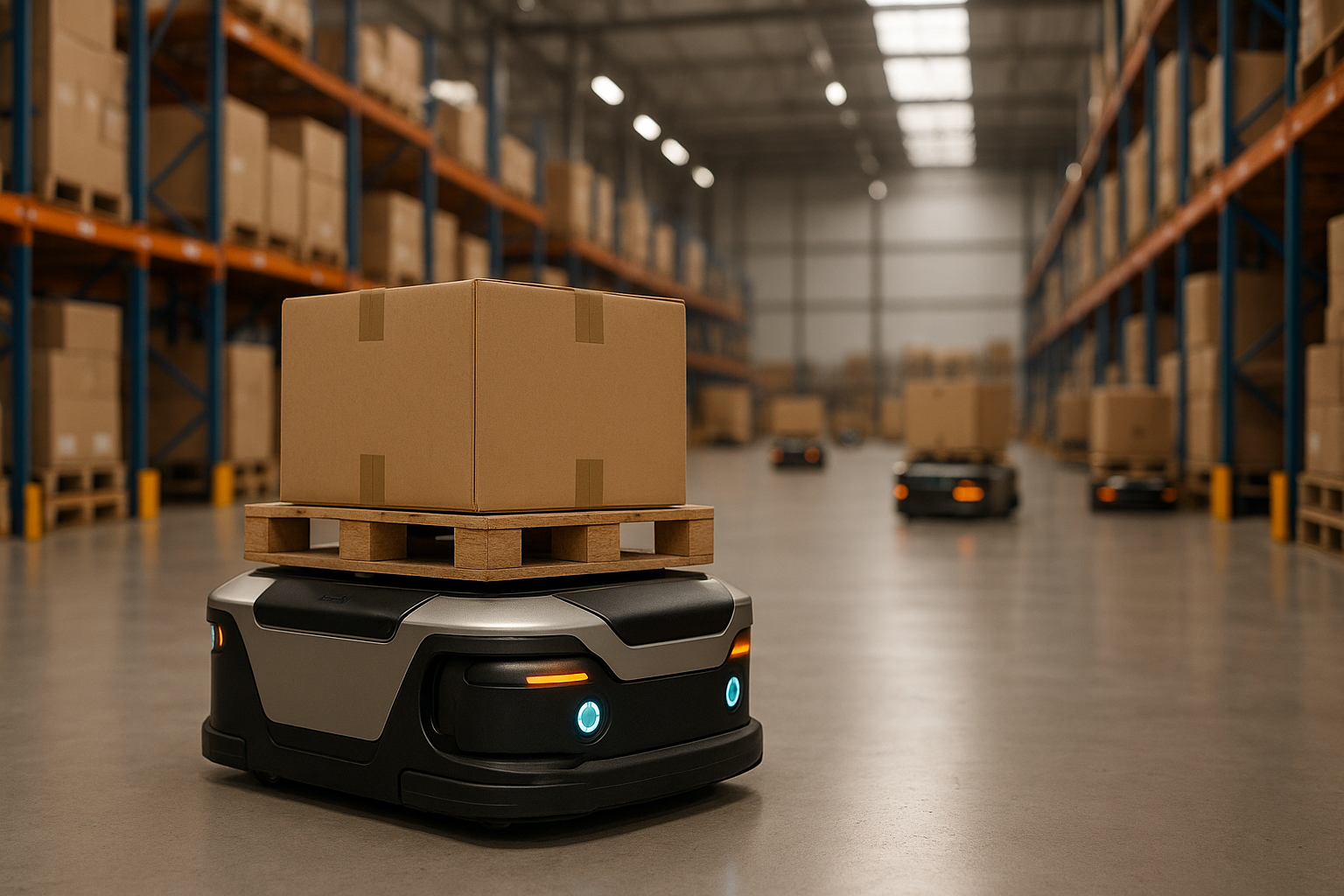
Autonomous Mobile Robots (AMRs) are transforming warehouse operations by delivering unprecedented efficiency, accuracy, and flexibility in modern supply chain management.

🤖 The Dawn of Intelligent Warehouse Automation
The logistics industry stands at a pivotal moment in its evolution. Traditional warehouse operations, once dominated by manual labor and fixed conveyor systems, are rapidly giving way to intelligent, self-navigating robots that are redefining how goods move through distribution centers. Autonomous Mobile Robots represent a quantum leap forward from their predecessors, combining artificial intelligence, advanced sensors, and sophisticated navigation systems to create truly adaptive material handling solutions.
Unlike Automated Guided Vehicles (AGVs) that follow predetermined paths using magnetic strips or wires, AMRs use dynamic mapping and real-time decision-making to navigate warehouse environments. This fundamental difference allows them to work alongside human workers safely, adapt to changing floor layouts, and optimize their routes continuously based on current conditions.
The global market for warehouse automation is experiencing explosive growth, with AMRs leading the charge. Industry analysts project the autonomous mobile robot market will exceed $15 billion by 2030, driven by labor shortages, rising e-commerce demands, and the relentless pursuit of operational efficiency.
Understanding the Technology Behind Autonomous Navigation
The sophisticated technology enabling AMRs to operate independently relies on multiple integrated systems working in harmony. At the core lies simultaneous localization and mapping (SLAM) technology, which allows robots to build and update maps of their environment while tracking their position within that space.
Modern AMRs employ an array of sensors including LiDAR, cameras, ultrasonic sensors, and time-of-flight sensors to perceive their surroundings in three dimensions. This multi-sensor approach creates redundancy and accuracy, enabling robots to detect obstacles as small as a few centimeters and react in milliseconds.
Artificial intelligence and machine learning algorithms process this sensor data to make real-time navigation decisions. Advanced AMRs learn from experience, improving their path planning and obstacle avoidance capabilities over time. They can predict human movement patterns, anticipate congestion points, and select optimal routes that balance speed with safety.
Fleet Management Systems: The Brain Behind the Operation
Individual AMR intelligence is only part of the equation. Fleet management systems coordinate multiple robots, assigning tasks, managing traffic flow, and optimizing overall warehouse productivity. These cloud-based platforms integrate with existing warehouse management systems (WMS) and enterprise resource planning (ERP) software to create seamless operational workflows.
The fleet management system monitors battery levels, schedules charging cycles, tracks maintenance requirements, and provides real-time analytics on performance metrics. This centralized control ensures that the right number of robots are deployed for current demand levels while preventing bottlenecks and collisions.
📦 Transforming Key Warehouse Operations
The impact of AMRs extends across virtually every warehouse function, from receiving and put-away to picking, packing, and shipping. Their versatility allows them to adapt to different tasks and workflows without extensive reprogramming or infrastructure modifications.
Revolutionizing Order Picking Efficiency
Order picking traditionally accounts for over 50% of warehouse labor costs and represents the most time-consuming warehouse activity. AMRs are dramatically changing this equation through goods-to-person picking strategies. Instead of workers walking miles daily through warehouse aisles, robots bring products directly to ergonomic picking stations.
This transformation delivers multiple benefits simultaneously. Picking productivity increases by 200-300% in many implementations, while worker fatigue decreases substantially. Order accuracy improves as workers remain in well-lit, organized stations with verification systems. The time saved translates directly into faster order fulfillment and improved customer satisfaction.
Collaborative picking systems represent another innovative approach where AMRs follow human pickers through the warehouse, carrying totes and eliminating the need for workers to push heavy carts. This partnership combines human decision-making and dexterity with robotic endurance and navigation capabilities.
Optimizing Inventory Management and Replenishment
AMRs equipped with scanning technology can perform continuous inventory audits while completing other tasks, providing real-time inventory accuracy that was previously impossible without dedicated staff and significant time investment. This perpetual inventory capability eliminates the need for disruptive wall-to-wall physical counts.
Automated replenishment processes ensure picking locations remain stocked without human intervention. AMRs monitor inventory levels through integration with the WMS and proactively move products from reserve storage to forward picking locations based on demand patterns and predictive analytics.
💼 Business Impact: ROI and Operational Benefits
The financial case for AMR implementation has become increasingly compelling as technology costs decrease and labor challenges intensify. While initial investment varies based on facility size and automation scope, most organizations achieve return on investment within 18-36 months.
Labor savings represent the most immediately apparent benefit. AMRs don’t eliminate human workers but rather augment their capabilities and redirect labor toward higher-value activities. Facilities typically redeploy workers from repetitive transport tasks to quality control, exception handling, and customer service functions.
Beyond direct labor costs, AMRs deliver substantial operational improvements:
- Throughput increases of 25-40% through extended operating hours and consistent performance
- Order accuracy improvements from 95% to 99.5%+ reducing returns and customer service costs
- Space utilization optimization through dynamic slotting and high-density storage configurations
- Reduced workplace injuries and workers’ compensation costs
- Enhanced scalability allowing rapid response to demand fluctuations without lengthy hiring processes
Flexibility: The Hidden Value Proposition
Perhaps the most underestimated advantage of AMRs is their inherent flexibility compared to fixed automation systems. Traditional conveyor-based automation requires significant capital investment, lengthy installation periods, and permanent floor modifications. Changes to product mix, facility layout, or operational processes demand expensive reconfiguration.
AMRs, by contrast, adapt to new requirements through software updates. Expanding capacity simply means adding more robots to the existing fleet. Seasonal peaks can be managed through temporary robot leasing arrangements. Facilities can reconfigure storage layouts overnight without ripping out and reinstalling physical infrastructure.
🏭 Real-World Implementation Success Stories
Leading retailers, third-party logistics providers, and manufacturers worldwide have successfully deployed AMR fleets with impressive results. A major North American retailer implemented 300 AMRs across multiple distribution centers, achieving a 40% increase in productivity while reducing overtime costs by 30%.
An automotive parts supplier integrated collaborative AMRs into their manufacturing facility, resulting in a 50% reduction in forklift traffic and a significant improvement in workplace safety metrics. The robots handle over 1,000 material movements daily, allowing human operators to focus on complex assembly tasks.
E-commerce fulfillment centers face perhaps the most demanding operational requirements, with extreme order volumes and customer expectations for same-day or next-day delivery. Multiple online retailers have deployed AMR fleets exceeding 500 units in single facilities, processing hundreds of thousands of orders daily during peak periods.
Navigating Implementation Challenges
Despite compelling benefits, successful AMR implementation requires careful planning and realistic expectations. Organizations must address several key considerations to maximize their investment and avoid common pitfalls.
Infrastructure and Facility Readiness
While AMRs require less infrastructure modification than traditional automation, facilities must still meet certain requirements. Floor conditions significantly impact robot performance—cracks, uneven surfaces, and excessive debris can interfere with navigation sensors and wheel mechanisms. Adequate WiFi coverage and network bandwidth are essential for real-time communication between robots and fleet management systems.
Lighting conditions, reflective surfaces, and transparent obstacles like glass doors can challenge sensor systems. Conducting thorough facility assessments and pilot programs helps identify and address these environmental factors before full-scale deployment.
Workforce Integration and Change Management
Technology success ultimately depends on human acceptance and adaptation. Workers may initially fear job displacement or struggle to trust robot colleagues. Comprehensive change management programs addressing these concerns prove critical for smooth transitions.
Successful organizations invest heavily in training programs that help workers understand AMR capabilities, limitations, and proper interaction protocols. They communicate transparently about how roles will evolve and create opportunities for workers to develop new skills in robot fleet management and maintenance.
Engaging employees early in the implementation process, soliciting feedback, and demonstrating how robots reduce physical strain rather than eliminate jobs builds support and accelerates adoption.
🔮 The Future of Autonomous Warehouse Robotics
The AMR revolution continues accelerating with technological advances expanding capabilities and opening new applications. Several emerging trends will shape the next generation of warehouse automation.
Enhanced Manipulation Capabilities
Current AMRs excel at transportation but typically require human intervention for picking and placing individual items. Next-generation systems integrate advanced robotic arms with sophisticated vision systems and AI-powered grasp planning, enabling autonomous handling of diverse products without human assistance.
Machine learning algorithms trained on millions of picking operations can now handle irregular shapes, deformable items, and fragile products with increasing reliability. As this technology matures, fully autonomous order fulfillment becomes feasible for a growing range of product categories.
Collaborative Intelligence and Swarm Behaviors
Future AMR fleets will exhibit increasingly sophisticated collective behaviors inspired by natural swarms. Rather than following centralized instructions, robots will communicate directly with each other, self-organizing to optimize overall system performance. This distributed intelligence approach promises greater resilience, faster adaptation to disruptions, and emergent problem-solving capabilities.
Cross-Industry Expansion
While warehousing and distribution currently dominate AMR applications, the technology is expanding into manufacturing, healthcare, hospitality, and retail environments. Hospitals deploy AMRs for medication delivery and linen transport. Hotels use robots for room service and luggage handling. Grocery stores pilot systems for inventory audits and customer assistance.
This diversification drives technology improvements that benefit all applications while reducing costs through economies of scale and increased competition among suppliers.
⚖️ Addressing Safety and Regulatory Considerations
Safety remains paramount when deploying autonomous systems in environments shared with human workers. Modern AMRs incorporate multiple redundant safety systems including emergency stop buttons, collision avoidance sensors, and speed reduction in high-traffic zones.
Industry standards like ANSI/ITSDF B56.5 provide guidance on safe AMR design and operation. Regulatory frameworks continue evolving to address autonomous system deployment, with organizations like OSHA developing specific guidelines for human-robot collaboration in industrial settings.
Responsible implementation includes comprehensive risk assessments, clearly marked robot zones, appropriate signage, and protocols for emergency situations. Organizations must maintain detailed safety logs, conduct regular system audits, and foster a culture where workers feel empowered to report concerns or near-miss incidents.
Strategic Considerations for Decision Makers
Organizations evaluating AMR implementation should approach the decision strategically rather than viewing it simply as a technology purchase. Success requires alignment between automation capabilities and business objectives, realistic assessment of organizational readiness, and commitment to ongoing optimization.
Start with clear definition of success metrics beyond simple ROI calculations. Consider improvements in customer satisfaction, employee retention, sustainability goals, and competitive positioning. Establish baseline measurements for key performance indicators before implementation to enable accurate impact assessment.
Pilot programs in limited areas provide valuable learning opportunities while limiting risk. These trials reveal integration challenges, validate projected benefits, and build organizational confidence before broader deployment.
Selecting the right technology partner proves equally important as choosing the right technology. Evaluate vendors based on their implementation experience, ongoing support capabilities, financial stability, and commitment to continuous innovation. The relationship extends far beyond initial installation.
🌱 Sustainability Benefits of Autonomous Robotics
As organizations increasingly prioritize environmental responsibility, AMRs contribute to sustainability goals in multiple ways. Electric-powered robots eliminate emissions within facilities and reduce overall energy consumption compared to diesel or propane-powered forklifts.
Optimized routing algorithms minimize unnecessary travel, further reducing energy use. Improved inventory accuracy decreases waste from obsolescence and spoilage. Space optimization enabled by AMRs allows more efficient facility designs with reduced heating, cooling, and lighting requirements.
The extended operational lifespan of quality AMR systems, combined with upgradeability through software updates, reduces electronic waste compared to frequent replacement of traditional equipment. Many manufacturers offer battery recycling programs and use sustainable materials in robot construction.
Building Tomorrow’s Intelligent Supply Chain
Autonomous Mobile Robots represent far more than incremental improvement in warehouse operations—they embody a fundamental transformation in how physical goods flow through supply chains. As technology continues advancing and implementation expertise grows, the competitive disadvantage of not adopting these systems will become increasingly pronounced.
Organizations that view AMR implementation as a journey rather than a destination position themselves for ongoing success. The first robots deployed mark the beginning of continuous improvement cycles, with each iteration leveraging new capabilities, expanding to additional processes, and delivering compounding benefits.
The convergence of robotics, artificial intelligence, Internet of Things sensors, and cloud computing creates possibilities that seemed like science fiction just years ago. Warehouses are evolving into highly orchestrated environments where humans and machines collaborate seamlessly, each contributing their unique strengths to create supply chain operations that are faster, more accurate, safer, and more adaptable than ever before.
The revolution in warehouse logistics driven by Autonomous Mobile Robots continues gaining momentum, reshaping not just how products move through facilities but fundamentally reimagining what’s possible in modern supply chain management. For forward-thinking organizations, the question is no longer whether to embrace this transformation but how quickly they can accelerate their journey toward autonomous operations.