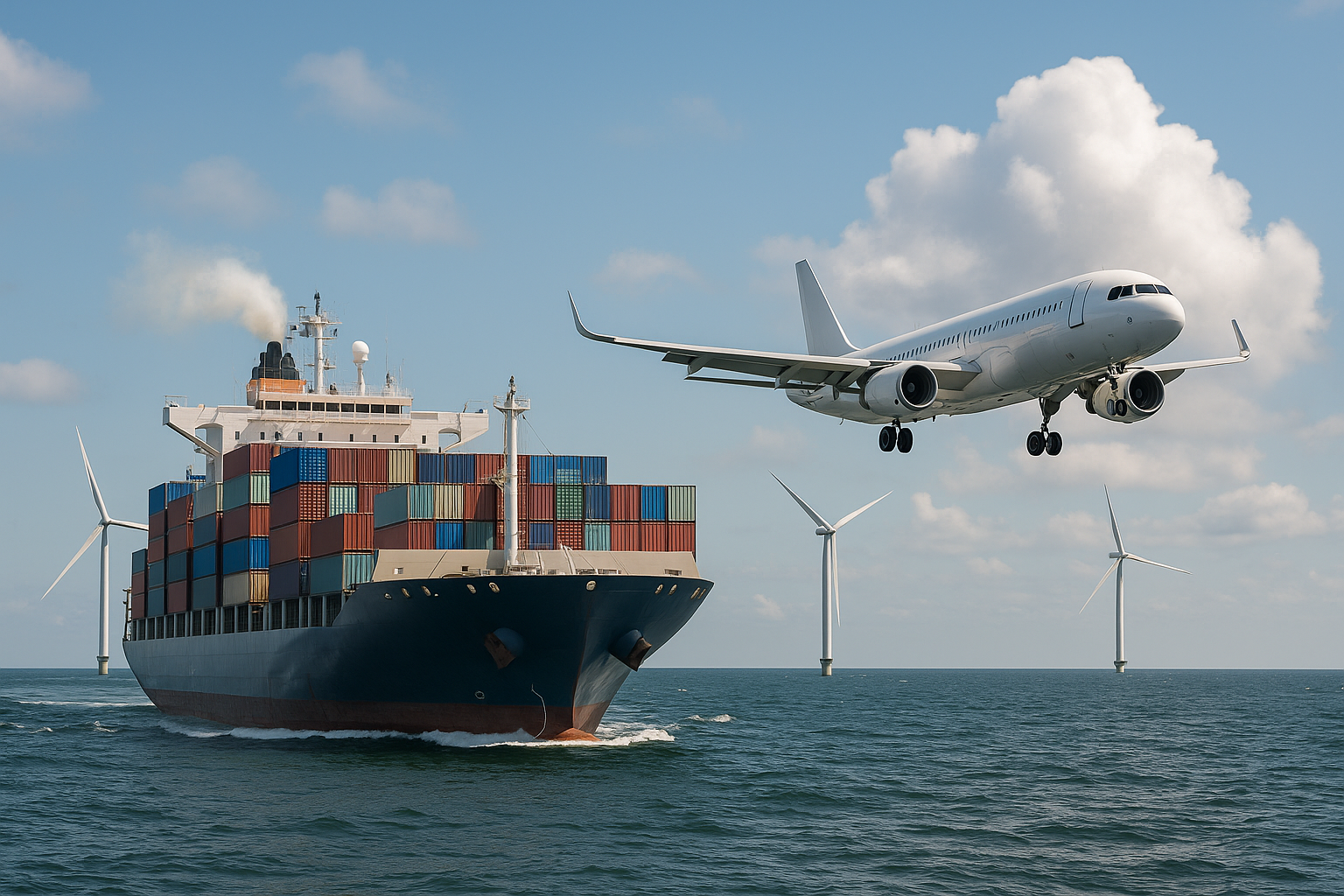
The race to decarbonize two of the world’s most carbon-intensive sectors—shipping and aviation—has officially taken flight and set sail, driven by urgent climate targets and innovative technological solutions.

🌍 Why Decarbonization in Shipping and Aviation Matters Now More Than Ever
Global aviation and maritime shipping collectively account for approximately 5-8% of worldwide greenhouse gas emissions, yet they’ve historically remained under the radar compared to other industries. As nations commit to net-zero targets by 2050, these hard-to-abate sectors face unprecedented pressure to transform their operations fundamentally.
The International Maritime Organization (IMO) has set ambitious targets to reduce shipping emissions by at least 50% by 2050 compared to 2008 levels, while the International Civil Aviation Organization (ICAO) aims for carbon-neutral growth from 2020 onwards. These regulatory frameworks are pushing companies to innovate at breakneck speed, creating a perfect storm of opportunity for clean technology adoption.
The challenge is immense: ships and aircraft require enormous amounts of energy to move massive weights across vast distances. Unlike road transport, where electric vehicles offer a clear pathway forward, these sectors demand solutions that can deliver high energy density without compromising safety, performance, or economic viability.
⚓ Maritime Shipping Charts a Course Toward Zero Emissions
The shipping industry moves approximately 90% of global trade, making it the backbone of the world economy. Decarbonizing this sector requires a multifaceted approach that addresses both existing vessels and new builds, while considering the long operational lifespans of maritime assets.
Alternative Fuels Making Waves in Maritime Transport
Liquefied natural gas (LNG) has emerged as a transitional fuel, reducing carbon dioxide emissions by up to 25% compared to conventional marine fuel oil. However, concerns about methane slip—the unintended release of methane during operations—have prompted the industry to look beyond LNG toward truly zero-carbon solutions.
Green ammonia and green methanol are gaining significant traction as potential game-changers. These fuels, produced using renewable energy, offer energy densities suitable for long-haul voyages. Major shipping companies like Maersk have already ordered vessels capable of running on green methanol, with deliveries expected in the coming years.
Hydrogen, particularly in liquid form, presents another promising pathway. While storage and bunkering infrastructure remain challenges, several pilot projects are demonstrating the feasibility of hydrogen-powered vessels for specific applications, particularly in ferry and coastal shipping operations.
Wind-Assisted Propulsion: Old Technology, New Applications
In a fascinating return to maritime history, modern wind-assisted propulsion systems are making a comeback with cutting-edge technology. Rotor sails, kites, and rigid wing sails can reduce fuel consumption by 10-30% depending on routes and weather conditions.
Companies like Norsepower and Airseas are deploying these systems on commercial vessels, proving that harnessing wind power isn’t just romantic nostalgia—it’s a practical decarbonization strategy. The beauty of these solutions lies in their compatibility with existing vessels, making them attractive retrofit options.
Digitalization and Operational Efficiency at Sea
Smart shipping solutions leveraging artificial intelligence, big data analytics, and Internet of Things sensors are optimizing routes, reducing idle time, and improving fuel efficiency. Weather routing algorithms can save 3-5% in fuel consumption by identifying the most efficient paths considering currents, waves, and wind patterns.
Port call optimization reduces time spent at anchor and during berthing operations, cutting emissions significantly. Blockchain-enabled systems are improving supply chain coordination, reducing delays and unnecessary fuel consumption throughout the logistics chain.
✈️ Aviation Industry Reaches for Carbon-Neutral Skies
Aviation presents unique challenges due to extreme safety requirements, weight constraints, and the need for high energy density fuels. Despite these obstacles, the industry is pursuing multiple parallel strategies to achieve ambitious decarbonization goals.
Sustainable Aviation Fuel: The Near-Term Solution
Sustainable Aviation Fuel (SAF) represents the most immediately scalable solution for reducing aviation emissions. These drop-in fuels, produced from waste oils, agricultural residues, or synthetic processes, can reduce lifecycle carbon emissions by up to 80% compared to conventional jet fuel.
SAF requires no modifications to existing aircraft or infrastructure and can be blended with conventional fuel. Airlines including United, KLM, and Qantas have committed to significant SAF uptake, while governments are implementing mandates and incentives to scale production rapidly.
The primary challenge remains supply and cost. Currently, SAF production represents less than 1% of total aviation fuel demand, with prices 2-4 times higher than conventional jet fuel. However, technological advances and economies of scale are expected to narrow this gap significantly by 2030.
Electric and Hybrid-Electric Aircraft Taking Off
For short-haul flights, electric propulsion is transitioning from concept to reality. Several companies are developing all-electric aircraft for regional routes under 500 miles, with passenger capacities ranging from 9 to 100 seats.
Heart Aerospace, Eviation, and others are conducting test flights and securing orders from major airlines and regional operators. These aircraft promise zero direct emissions, significantly lower operating costs, and reduced noise pollution—a triple win for sustainability, economics, and community relations.
Hybrid-electric systems offer a stepping stone for larger aircraft, combining conventional engines with electric motors to reduce fuel consumption and emissions during critical flight phases like takeoff and landing.
Hydrogen-Powered Flight: The Long-Term Vision
Major manufacturers including Airbus have announced ambitious programs to develop hydrogen-powered commercial aircraft by 2035. Hydrogen combustion produces only water vapor as a direct emission, offering a pathway to truly zero-carbon flight.
Two primary approaches are being explored: hydrogen combustion in modified gas turbine engines, and hydrogen fuel cells powering electric motors. Each presents distinct advantages and challenges related to storage, weight, safety, and infrastructure requirements.
The aviation industry must develop entirely new supply chains for hydrogen production, liquefaction, transport, storage, and refueling at airports worldwide—a monumental undertaking requiring coordinated investment across multiple sectors.
🔄 The Infrastructure Challenge: Building the Foundation for Change
Decarbonization strategies in shipping and aviation cannot succeed without massive infrastructure investments. Ports, airports, and surrounding ecosystems must transform to support new fuel types, charging systems, and operational paradigms.
Port Electrification and Green Bunkering Networks
Shore power connections allow ships to shut down auxiliary engines while docked, eliminating emissions during port stays. Cold ironing infrastructure is expanding rapidly in major ports, supported by regulatory requirements in places like California and the European Union.
Bunkering facilities for alternative fuels require substantial capital investment. Green ammonia, methanol, and hydrogen terminals are being developed in strategic locations to create the initial nodes of global supply networks. Singapore, Rotterdam, and other major maritime hubs are competing to establish themselves as leaders in green bunkering infrastructure.
Airport Transformation for Sustainable Aviation
Airports are investing in SAF storage and distribution systems, often starting with dedicated facilities for SAF blending and refueling. Ground service equipment electrification eliminates emissions from baggage handlers, pushback tractors, and other support vehicles.
For electric aircraft, charging infrastructure with appropriate power capacity and safety systems must be integrated into existing airport layouts. For hydrogen aviation, entirely new systems for liquid hydrogen storage, handling, and refueling will be necessary—representing one of the industry’s most significant infrastructure challenges.
💰 Economic Considerations and Investment Trends
The transition to low-carbon shipping and aviation requires enormous capital investment, estimated in the hundreds of billions of dollars globally. However, economic incentives are increasingly aligning with environmental imperatives, creating attractive investment opportunities.
The True Cost of Carbon and Regulatory Pressures
Carbon pricing mechanisms, including the EU Emissions Trading System’s expansion to maritime and aviation, are making emissions increasingly expensive. These cost pressures create strong economic incentives for early adoption of decarbonization technologies.
The Carbon Offsetting and Reduction Scheme for International Aviation (CORSIA) requires airlines to offset growth in emissions above 2019 levels, while the IMO’s carbon intensity indicator mandates continuous efficiency improvements. Non-compliance carries financial penalties and reputational risks that forward-thinking companies are eager to avoid.
Green Finance Flowing into Transportation Transformation
Sustainability-linked loans, green bonds, and dedicated climate funds are channeling capital toward decarbonization projects. Shipping companies and airlines with credible transition plans are accessing favorable financing terms, while those lagging face higher capital costs and investor scrutiny.
Public-private partnerships are accelerating infrastructure development, with governments recognizing that their climate targets cannot be achieved without transformed transportation sectors. Innovation grants, research funding, and production subsidies are de-risking early-stage technologies and helping them scale toward commercial viability.
🌐 Global Collaboration: No Company or Country Can Go It Alone
Decarbonizing international shipping and aviation requires unprecedented global cooperation. These inherently international industries cannot transform through isolated national policies or individual corporate actions alone.
International Regulatory Frameworks Setting the Pace
The IMO and ICAO provide essential coordination mechanisms, establishing common standards that prevent competitive disadvantages and regulatory fragmentation. However, critics argue these bodies have historically moved too slowly, prompting regional actors like the European Union to implement more aggressive policies.
Harmonizing technical standards for new fuels, safety protocols, and infrastructure specifications prevents costly duplication and enables economies of scale in technology development and deployment.
Industry Coalitions Accelerating Progress
Collaborative initiatives like the Getting to Zero Coalition, Mission Possible Partnership, and Clean Skies for Tomorrow bring together companies across the value chain—from energy producers to end-users—to coordinate investments and de-risk first-mover disadvantages.
These coalitions create demand signals for alternative fuels and technologies, helping to bridge the chicken-and-egg problem where suppliers won’t invest without guaranteed demand, and buyers won’t commit without reliable supply.
🚀 Innovation Frontiers: Technologies Still on the Horizon
Beyond the solutions already being deployed, breakthrough technologies in development could further accelerate decarbonization timelines and expand the range of possible pathways.
Advanced Nuclear Propulsion for Shipping
While nuclear-powered vessels have long existed in military applications, small modular reactors designed for commercial shipping are being explored as a zero-emission power source for the largest vessels. Regulatory, safety, and public acceptance challenges remain significant, but the technology offers unmatched energy density.
Synthetic Fuels and Direct Air Capture
E-fuels produced by combining hydrogen with captured CO2 create carbon-neutral synthetic versions of conventional fuels. While currently expensive and energy-intensive to produce, continued innovation in direct air capture technology and renewable energy costs could make these fuels increasingly competitive.
Next-Generation Aircraft Design
Blended wing body designs, advanced materials, and revolutionary propulsion systems promise step-changes in aircraft efficiency. These innovations could reduce fuel consumption by 20-30% or more compared to current generation aircraft, complementing alternative fuel adoption.
⏰ The Urgency of Action: Timeline and Milestones
The window for meeting 2050 climate targets is narrowing rapidly. Given the long asset lifespans in shipping (25-30 years) and aviation (20-30 years), decisions made today will determine whether these sectors successfully decarbonize or become stranded in a carbon-constrained future.
The 2020s represent a critical decade for demonstration projects, initial commercialization, and infrastructure development. The 2030s must see mass adoption and scaling of proven solutions, with the 2040s focused on deploying final-generation technologies and phasing out remaining fossil fuel use.
Every year of delay compounds the challenge, requiring either more aggressive later action or acceptance that climate targets will be missed. The good news is that momentum is building, with technological breakthroughs, policy support, and market forces increasingly aligned toward transformation.
🌟 Charting the Course Forward: Integrated Strategies for Success
Successful decarbonization requires integrated strategies that recognize the interconnections between technology development, infrastructure investment, policy frameworks, and market dynamics. Neither shipping nor aviation will transform through any single solution—portfolio approaches acknowledging multiple viable pathways will prove most resilient.
Companies must balance near-term emissions reductions through operational efficiencies and transitional fuels with longer-term investments in breakthrough technologies. Governments must provide stable policy signals and support infrastructure development while allowing market mechanisms to drive efficient allocation of resources.
The transition represents not just an environmental imperative but an economic opportunity. First movers are positioning themselves as leaders in the industries of tomorrow, attracting capital, talent, and customers increasingly demanding sustainable options. Those who delay risk obsolescence in a rapidly transforming competitive landscape.
The journey toward decarbonized shipping and aviation has genuinely begun, with solutions moving from concept to reality at accelerating pace. While significant challenges remain, the combination of technological innovation, policy support, market pressure, and collaborative action is creating real momentum. The sky-high solutions needed are increasingly within reach—the question now is whether we’ll grasp them quickly enough to meet the urgent timeline our climate demands.