Artificial intelligence is transforming how governments and institutions anticipate crises, bringing unprecedented precision to forecasting economic disruptions and geopolitical tensions worldwide.

🌍 The New Era of Predictive Intelligence
In an increasingly interconnected world, the ripple effects of economic downturns and political instability can spread across continents within hours. Traditional forecasting methods, relying on historical data and human analysis, often struggle to keep pace with the velocity and complexity of modern global systems. This is where artificial intelligence emerges as a game-changing force, offering capabilities that seemed like science fiction just a decade ago.
AI monitoring systems now process billions of data points simultaneously, analyzing everything from satellite imagery tracking agricultural yields to social media sentiment indicating civil unrest. These systems identify patterns invisible to human observers, providing early warnings that enable proactive rather than reactive decision-making.
The revolution isn’t just about speed—it’s about depth and breadth of understanding. Machine learning algorithms can correlate seemingly unrelated events across different sectors and regions, revealing hidden connections that drive economic and political outcomes. This holistic approach represents a fundamental shift in how we understand and manage global stability.
📊 Decoding Economic Signals Before Markets React
Financial markets have always been notoriously difficult to predict, with countless variables influencing prices, currencies, and commodity values. AI monitoring platforms are changing this landscape by analyzing vast datasets that human traders could never comprehend in real-time.
These systems track millions of transactions, news articles, corporate filings, and economic indicators simultaneously. They detect subtle shifts in trading patterns, unusual capital flows, and emerging trends before they become visible to conventional analysis. Banks and investment firms using AI forecasting have reported significant improvements in risk management and portfolio optimization.
One particularly powerful application involves analyzing alternative data sources. AI systems now monitor credit card transactions, shipping container movements, parking lot occupancy captured by satellites, and even weather patterns to gauge economic activity with remarkable accuracy. This granular view provides leading indicators that traditional metrics simply cannot match.
Real-Time Supply Chain Intelligence
Supply chain disruptions have become a critical concern for global economic stability, as evidenced by recent events affecting everything from semiconductor production to food distribution. AI monitoring systems now provide unprecedented visibility into these complex networks.
These platforms track container ships, analyze port congestion, monitor factory activity through energy consumption data, and predict potential bottlenecks weeks or months before they materialize. Companies using these systems have reduced inventory costs while improving product availability, demonstrating the practical value of AI-driven predictions.
The technology goes beyond simple tracking. Advanced algorithms assess the vulnerability of supply chains to various disruptions, from natural disasters to political instability, enabling organizations to diversify sourcing and build resilience proactively.
🛡️ Anticipating Geopolitical Flashpoints
Political instability often erupts suddenly in the public consciousness, but the underlying tensions typically build over extended periods. AI monitoring systems excel at identifying these gradual escalations, providing crucial early warnings to governments, humanitarian organizations, and businesses operating in volatile regions.
Natural language processing algorithms analyze millions of news articles, government statements, and social media posts in dozens of languages, detecting shifts in rhetoric, rising tensions, and emerging narratives that precede conflicts. Image recognition technology processes satellite imagery to identify military buildups, refugee movements, and infrastructure changes that signal impending crises.
Intelligence agencies and international organizations increasingly rely on these tools to complement traditional human intelligence. The systems don’t replace human judgment but enhance it, flagging situations that require deeper analysis and urgent attention.
Social Media as a Geopolitical Barometer
Social platforms have become invaluable sources of real-time information about public sentiment and grassroots movements. AI systems analyze posts, hashtags, and network connections to gauge political stability, identify influential actors, and predict protest movements.
During periods of political transition or social unrest, these platforms often provide more timely information than official channels. Machine learning models trained on historical data can recognize patterns associated with escalating tensions, enabling preventive diplomacy and humanitarian preparedness.
The technology has proven particularly valuable in identifying misinformation campaigns and foreign influence operations that can destabilize political systems. By tracking how information spreads across networks, AI systems help defenders respond before false narratives gain irreversible momentum.
💡 Machine Learning Models That Learn and Adapt
What distinguishes modern AI monitoring from previous forecasting approaches is the ability to continuously learn and improve. These systems don’t rely on fixed algorithms; they adapt as new patterns emerge and circumstances change.
Neural networks trained on decades of economic and political data identify relationships that human analysts might miss. More importantly, they update their understanding as new information becomes available, refining predictions with each passing day.
This adaptive capability proves crucial in a world where unprecedented events—from pandemics to technological disruptions—regularly challenge existing assumptions. AI systems that learned from the 2008 financial crisis have been able to apply those lessons to subsequent economic shocks, albeit with necessary adjustments for changed contexts.
The Role of Alternative Data Sources
Beyond traditional economic indicators and news sources, AI monitoring platforms now incorporate data streams that were previously inaccessible or underutilized:
- Satellite imagery: Tracking everything from construction activity to agricultural health
- Internet of Things sensors: Monitoring infrastructure performance and industrial output
- Mobile phone data: Analyzing movement patterns and economic activity
- Environmental sensors: Assessing climate-related risks to stability
- Blockchain records: Tracking capital flows and trade patterns
The integration of these diverse data sources creates a multi-dimensional view of global conditions that was impossible to achieve through conventional methods. The challenge lies in effective data fusion—combining information from disparate sources into coherent, actionable insights.
🎯 Practical Applications Across Sectors
The impact of AI monitoring extends far beyond government intelligence agencies and financial institutions. Organizations across various sectors are leveraging these capabilities to navigate uncertainty and make better-informed decisions.
Multinational corporations use geopolitical risk assessment tools powered by AI to evaluate market entry decisions, protect overseas personnel, and anticipate regulatory changes. Humanitarian organizations deploy predictive systems to position resources before disasters strike, saving lives and reducing response costs.
Central banks increasingly incorporate AI-generated forecasts into monetary policy decisions, gaining insights into inflation pressures, employment trends, and financial stability risks. These tools don’t dictate policy but provide policymakers with more comprehensive information for their deliberations.
Insurance and Risk Management Revolution
The insurance industry has emerged as an early adopter of AI monitoring technologies, using them to assess and price political risk, climate-related exposures, and emerging threats that traditional actuarial methods struggle to quantify.
Insurers now model complex scenarios involving multiple interacting risk factors, from how political instability might affect supply chains to how climate change could trigger economic migration. This sophisticated risk assessment enables more accurate pricing and helps clients understand their exposures more completely.
⚖️ Ethical Considerations and Limitations
Despite their impressive capabilities, AI monitoring systems raise important ethical questions and face significant limitations that users must understand and address.
Privacy concerns emerge when systems analyze individual-level data, even when aggregated and anonymized. The line between legitimate security monitoring and invasive surveillance requires careful consideration, particularly when governments deploy these technologies.
Algorithmic bias represents another critical challenge. AI systems trained on historical data can perpetuate or amplify existing prejudices, potentially flagging certain communities or regions as higher risk based on biased training data rather than objective threat assessment.
Transparency also presents difficulties. Many advanced AI systems function as “black boxes,” producing accurate predictions without clearly explaining their reasoning. This opacity can undermine trust and make it difficult to validate or challenge predictions, particularly when they inform consequential decisions.
The Human Element Remains Essential
No matter how sophisticated AI monitoring becomes, human judgment, creativity, and ethical reasoning remain indispensable. Technology provides information and identifies patterns, but humans must interpret this intelligence within broader contexts that machines cannot fully grasp.
Cultural nuances, historical grievances, personal relationships between leaders, and moral considerations all influence outcomes in ways that algorithms struggle to model. Effective use of AI monitoring requires teams that combine technical expertise with deep domain knowledge and ethical frameworks.
Organizations that treat AI as a tool to augment human decision-making—rather than replace it—achieve the best results. This collaborative approach leverages the strengths of both artificial and human intelligence while mitigating their respective weaknesses.
🚀 The Future Landscape of Predictive Analytics
As AI technology continues advancing at a rapid pace, the capabilities of monitoring and prediction systems will expand dramatically over the coming years. Several emerging trends promise to further revolutionize this field.
Quantum computing may eventually enable AI systems to process even larger datasets and run more complex simulations, potentially allowing for longer-range forecasting and more nuanced scenario modeling. While still in early stages, quantum machine learning represents a frontier that could fundamentally transform predictive capabilities.
Integration of different AI approaches—combining deep learning, reinforcement learning, and symbolic reasoning—may produce systems that not only identify patterns but understand causality more deeply. This would enable more robust predictions that hold up under novel circumstances rather than simply extrapolating past patterns.
Democratization of Predictive Intelligence
As AI monitoring tools become more accessible and user-friendly, their benefits will extend beyond large institutions with significant resources. Small businesses, local governments, and civil society organizations will gain access to sophisticated forecasting previously available only to well-funded entities.
This democratization could reduce information asymmetries that currently advantage powerful actors, enabling more stakeholders to anticipate and prepare for challenges. However, it also raises concerns about malicious use and the need for responsible deployment frameworks.
🌐 Building Resilient Systems Through Better Foresight
The ultimate goal of AI monitoring isn’t perfect prediction—an impossible standard in complex systems—but rather enhanced resilience. By providing earlier warnings and deeper understanding of emerging risks, these technologies enable individuals, organizations, and societies to prepare and adapt more effectively.
Economic systems become more stable when financial institutions can identify vulnerabilities before they cascade into crises. Political systems gain legitimacy when governments can address grievances before they explode into violence. Supply chains function more reliably when disruptions are anticipated and mitigated.
This shift from reactive crisis management to proactive risk mitigation represents one of the most significant potential benefits of AI monitoring. Rather than simply responding faster to problems as they emerge, societies can increasingly prevent problems from materializing in the first place.
Collaborative Intelligence Networks
The future of AI monitoring likely involves interconnected systems that share insights across organizational and national boundaries. When multiple entities contribute data and validate predictions, the collective intelligence becomes more accurate and comprehensive than any single system could achieve.
Such collaboration requires overcoming significant technical, legal, and political obstacles. Privacy protections, data sovereignty concerns, and competitive interests all complicate information sharing. Nevertheless, pilot initiatives demonstrate that carefully designed frameworks can enable productive collaboration while respecting these constraints.
🔮 Transforming Uncertainty into Strategic Advantage
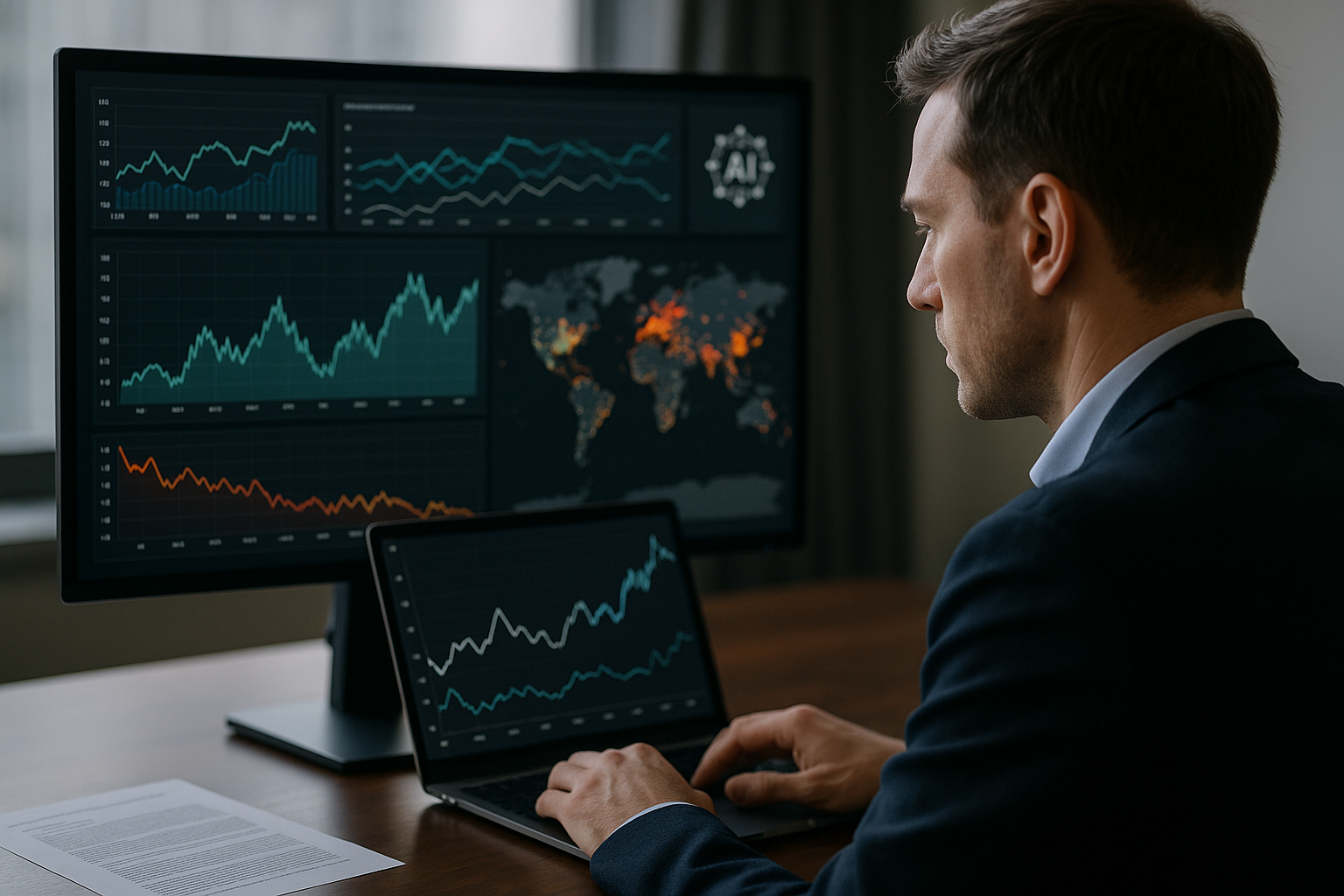
In a world characterized by volatility and rapid change, the ability to anticipate developments provides enormous strategic advantages. AI monitoring systems are democratizing this capability, making sophisticated forecasting accessible beyond elite institutions.
As these technologies mature and proliferate, we’re witnessing a fundamental shift in how humanity manages collective risks. The unpredictable becomes slightly more predictable; the unknowable becomes partially knowable. This doesn’t eliminate uncertainty—an inherent feature of complex systems—but it narrows the range of possible futures and highlights which scenarios deserve our attention and preparation.
The organizations and societies that most effectively integrate AI monitoring into their decision-making processes will likely prove more resilient and adaptive in coming decades. They’ll anticipate shifts in the economic landscape, prepare for geopolitical challenges, and position themselves advantageously as conditions evolve.
Yet technology alone cannot guarantee stability or prosperity. AI monitoring provides information, but wisdom, courage, and cooperation determine how we use that information. The revolution in predictive intelligence creates opportunities for more informed choices, but the choices themselves remain profoundly human—reflecting our values, priorities, and aspirations for the future we wish to create together.
As we stand at this technological threshold, the question isn’t whether AI will transform how we anticipate and manage economic and geopolitical risks—that transformation is already underway. The crucial questions concern how we guide this transformation, ensuring these powerful tools serve human flourishing rather than undermining it, and how we build systems that enhance rather than replace the judgment, creativity, and moral reasoning that remain distinctly and essentially human.