
Collaborative robots, or cobots, are transforming modern warehouses by working alongside human teams to streamline operations, reduce costs, and improve accuracy in ways traditional automation never could.

🤖 Understanding the Cobot Revolution in Warehouse Environments
The warehouse industry stands at a pivotal intersection of labor challenges, e-commerce growth, and technological advancement. Traditional automation systems, while powerful, often require significant capital investment, extensive safety barriers, and complete workflow redesigns. Cobots represent a fundamentally different approach—one that emphasizes human-machine collaboration rather than replacement.
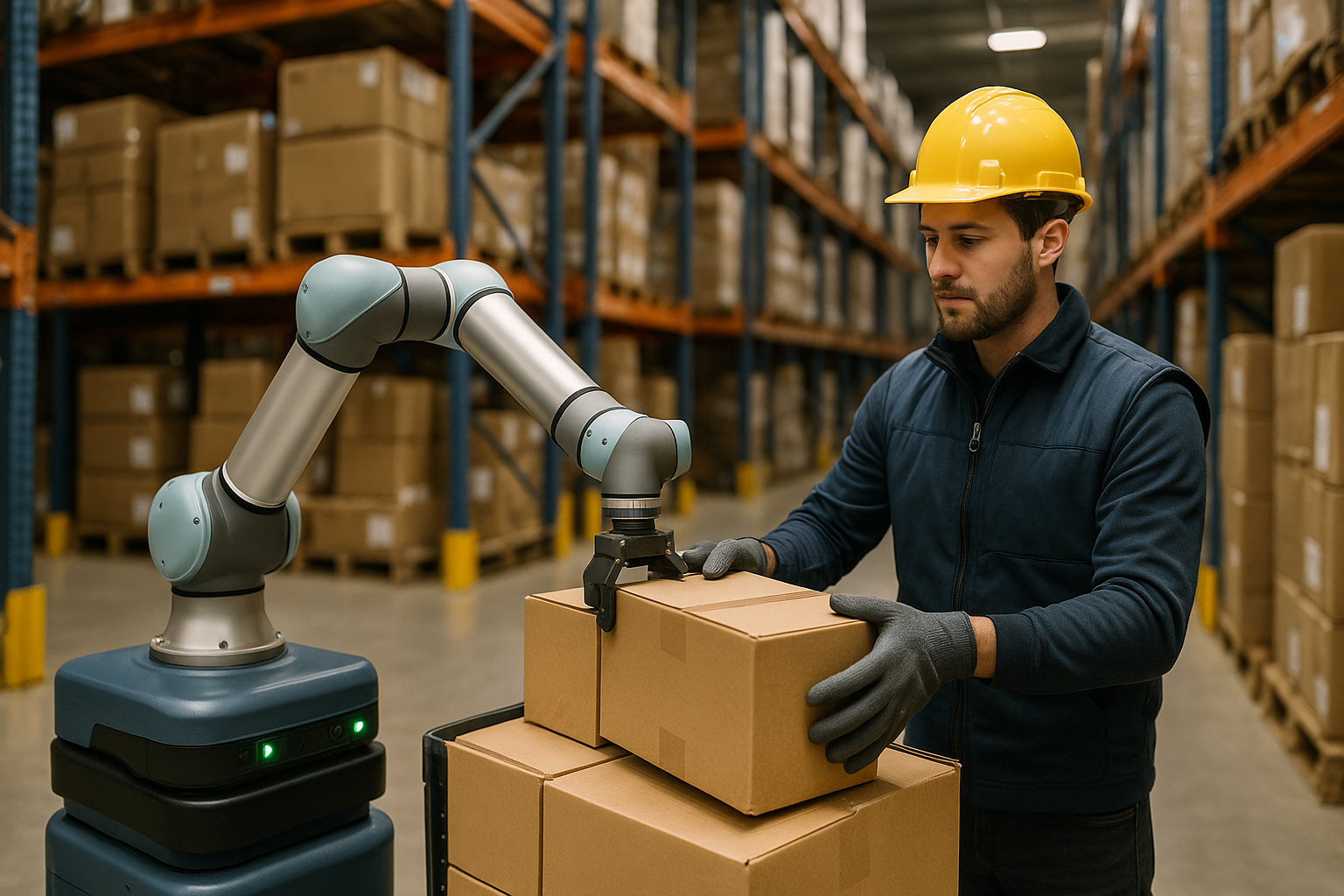
Unlike their industrial robot cousins, cobots are designed with built-in safety features that allow them to operate in close proximity to human workers without extensive safety caging. They’re equipped with advanced sensors, force-limiting capabilities, and intuitive programming interfaces that make them accessible to warehouse operations of all sizes. This democratization of robotics technology is opening doors for small and medium-sized warehouses that previously couldn’t justify the investment in traditional automation.
The global cobot market has experienced remarkable growth, with warehouse and logistics applications representing one of the fastest-expanding segments. This isn’t surprising when you consider the perfect storm of factors driving adoption: persistent labor shortages, rising customer expectations for faster delivery, increasing order complexity with smaller batch sizes, and the physical demands of warehouse work that contribute to high turnover rates.
📦 Key Areas Where Cobots Excel in Warehouse Operations
Picking and Packing Operations
Order fulfillment represents one of the most labor-intensive aspects of warehouse operations, and it’s precisely where cobots deliver exceptional value. Modern cobots equipped with vision systems and advanced gripping technology can identify, select, and handle items of varying sizes, shapes, and weights with impressive accuracy.
In collaborative picking scenarios, cobots work alongside human operators in a symbiotic relationship. The cobot might handle the heavy lifting or repetitive retrieval of common items, while the human worker manages exceptions, quality checks, and items requiring delicate handling or judgment. This division of labor plays to the strengths of both parties—robots for consistency and endurance, humans for adaptability and decision-making.
The accuracy improvements are substantial. While human pick rates typically achieve 99.5% accuracy under optimal conditions, fatigue and distraction can reduce this significantly during long shifts. Cobots maintain consistent accuracy throughout operation, and when paired with human oversight, combined accuracy rates often exceed 99.9%, dramatically reducing costly returns and customer dissatisfaction.
Material Handling and Transportation
Mobile cobots, often called autonomous mobile robots (AMRs), have revolutionized internal warehouse transportation. These intelligent machines navigate warehouse floors using sophisticated mapping and sensor technologies, transporting goods between receiving, storage, picking, and shipping areas without human intervention.
What sets modern AMRs apart is their adaptability. Unlike traditional automated guided vehicles (AGVs) that follow fixed paths, cobots can dynamically reroute around obstacles, optimize their paths based on real-time conditions, and even coordinate with other robots to prevent traffic congestion. This flexibility means warehouses can reconfigure layouts without reprogramming entire systems.
The physical relief for warehouse workers is significant. Studies show that warehouse personnel spend up to 70% of their shift walking, often covering 10-15 miles daily. By delegating transportation tasks to mobile cobots, workers remain in designated zones, reducing fatigue and allowing them to focus on value-adding activities that require human judgment and dexterity.
Sorting and Quality Control
Cobots equipped with vision systems and artificial intelligence are transforming quality control processes. These systems can inspect products at speeds impossible for human workers while maintaining consistent standards. They can detect defects, verify labels, confirm proper packaging, and sort items based on multiple criteria simultaneously.
The learning capabilities of modern cobots mean they continuously improve. Machine learning algorithms analyze patterns in defects, packaging issues, or sorting requirements, becoming more accurate over time. This creates a continuously improving quality control process that adapts to new products and changing standards without extensive reprogramming.
💡 The Business Case: Quantifying Cobot Benefits
Understanding the return on investment for cobot implementation requires examining both direct and indirect benefits. The financial justification extends far beyond simple labor cost calculations.
Productivity Gains and Throughput Improvements
Warehouses implementing cobots typically report productivity increases between 25% and 60%, depending on the application. These gains stem from several factors: cobots work continuously without breaks, maintain consistent performance throughout shifts, and can often operate during off-peak hours with minimal supervision.
A mid-sized distribution center handling 10,000 orders daily might see throughput increase to 14,000-15,000 orders with strategic cobot deployment, without proportional increases in labor costs or facility space. This scalability without geometric cost increases represents a fundamental shift in warehouse economics.
Labor Optimization and Workplace Safety
The warehouse labor challenge goes beyond simple availability. High turnover rates, training costs, and workplace injuries create substantial hidden expenses. Cobots address multiple dimensions of this challenge simultaneously.
By handling the most physically demanding and repetitive tasks, cobots reduce workplace injuries. Musculoskeletal disorders account for approximately 30% of warehouse workers’ compensation claims. Facilities implementing cobots for heavy lifting and repetitive motion tasks report injury rate reductions of 40-70%, translating to significant cost savings in workers’ compensation, lost time, and productivity.
Employee retention also improves when workers are freed from the most monotonous or physically punishing tasks. Warehouses report turnover reductions of 15-30% after cobot implementation, as jobs become more engaging and less physically demanding. Considering that recruiting and training a warehouse worker typically costs $3,000-$5,000, retention improvements deliver substantial value.
Flexibility and Scalability Advantages
Traditional automation systems often lock warehouses into fixed configurations that become liabilities as business needs evolve. Cobots offer unprecedented flexibility. Most can be reprogrammed for new tasks in hours or days rather than weeks or months, and they can be redeployed to different areas as priorities shift.
This flexibility proves particularly valuable for warehouses handling seasonal fluctuations. Rather than hiring and training temporary workers for peak seasons—a process that typically takes 2-3 weeks and results in initially lower productivity—cobots can be rapidly scaled up or redeployed from lower-priority tasks to high-demand areas.
🔧 Implementation Strategies for Successful Cobot Integration
Assessment and Planning Phase
Successful cobot implementation begins with thorough process analysis. Not every warehouse task benefits equally from cobot assistance. The highest-value applications typically involve high-volume, repetitive tasks with consistent parameters, significant physical demands, or critical accuracy requirements.
Conducting a comprehensive workflow analysis helps identify these opportunities. Map current processes, document cycle times, identify bottlenecks, and assess which tasks create the greatest burden for human workers. This analysis should involve floor-level employees who understand the nuances of daily operations and can identify practical challenges that might not be apparent from process documentation alone.
Consider starting with pilot projects rather than wholesale automation. Implementing cobots in one area allows you to develop expertise, refine processes, and demonstrate value before expanding. Successful pilots build organizational confidence and provide concrete data for justifying broader deployment.
Technology Selection and Integration
The cobot market offers numerous options, each with distinct capabilities, price points, and integration requirements. Key selection criteria should include payload capacity, reach and workspace requirements, speed and cycle time, ease of programming and reprogramming, safety certifications, and integration capabilities with existing warehouse management systems.
System integration represents a critical success factor often underestimated in initial planning. Cobots deliver maximum value when seamlessly integrated with warehouse management systems (WMS), enterprise resource planning (ERP) systems, and other operational technologies. This integration enables real-time coordination, data-driven optimization, and comprehensive performance monitoring.
Workforce Preparation and Change Management
Technology represents only half the equation—people determine implementation success. Warehouse workers may initially view cobots with skepticism or concern about job security. Proactive communication and inclusive change management are essential.
Frame cobot implementation as augmentation rather than replacement. Emphasize how cobots will eliminate the most physically demanding and monotonous aspects of jobs while creating opportunities for workers to develop new skills and take on more engaging responsibilities. Involve workers in implementation planning, seeking their input on workflow design and identifying potential challenges.
Comprehensive training programs ensure workers can effectively collaborate with cobots. This training should cover basic operation, safety protocols, troubleshooting common issues, and understanding when human intervention is needed. Creating cobot “champions” among the workforce—early adopters who can mentor colleagues and advocate for the technology—accelerates adoption and builds confidence.
📊 Measuring Success: Key Performance Indicators
Establishing clear metrics from the outset enables objective assessment of cobot performance and guides continuous improvement efforts. Effective measurement frameworks balance operational, financial, and qualitative indicators.
- Throughput metrics: Orders processed per hour, units picked per shift, or inventory moved per day, compared across pre and post-implementation periods
- Accuracy rates: Picking accuracy, sorting errors, quality control defect detection rates, and return/rework percentages
- Labor metrics: Labor hours per order, overtime requirements, temporary labor utilization, and employee retention rates
- Safety indicators: Workplace injury frequency and severity, workers’ compensation claims, and near-miss incidents
- Financial performance: Cost per order, labor cost as percentage of revenue, return on investment timeline, and total cost of ownership
- Utilization rates: Cobot operating hours versus available hours, idle time analysis, and multi-shift deployment effectiveness
Regular performance reviews, ideally monthly during initial implementation and quarterly thereafter, help identify optimization opportunities and ensure cobots are delivering expected value. These reviews should examine both quantitative metrics and qualitative feedback from operators working alongside cobots daily.
🚀 Future Trends: The Evolution of Warehouse Cobots
Artificial Intelligence and Machine Learning Integration
The next generation of warehouse cobots will leverage increasingly sophisticated AI capabilities. These systems will learn from experience, optimizing their own performance over time without human programming. Predictive algorithms will anticipate demand patterns, positioning inventory and resources proactively rather than reactively.
Vision systems are becoming dramatically more capable, enabling cobots to handle previously impossible tasks. Advanced image recognition can identify products regardless of orientation, assess quality with near-human judgment, and even read handwritten notes or damaged labels. This expands the range of warehouse tasks suitable for cobot assistance.
Enhanced Collaboration and Coordination
Future warehouse environments will feature fleets of cobots that communicate and coordinate with each other, optimizing warehouse-wide operations in real-time. These distributed intelligence systems will dynamically allocate resources, balance workloads, and adapt to changing conditions without centralized control.
Human-cobot interfaces will become more intuitive, with natural language processing enabling voice commands and conversational interaction. Augmented reality systems may provide visual overlays that help workers understand cobot status, intentions, and coordination requirements, further streamlining collaboration.
Sustainability and Environmental Considerations
Energy efficiency is becoming a key differentiator in cobot design. Next-generation systems incorporate energy harvesting, optimized movement algorithms that minimize power consumption, and intelligent charging strategies that leverage off-peak electricity rates. These improvements align warehouse automation with broader corporate sustainability goals.
Cobots also contribute to sustainability through waste reduction. Improved accuracy means fewer damaged products, returns, and disposal requirements. Optimized space utilization enabled by cobot efficiency can reduce warehouse footprints and associated energy consumption for lighting, heating, and cooling.
🎯 Making the Leap: Getting Started with Cobots
For warehouse operations considering cobots, the journey begins with education and exploration. Attend industry demonstrations, visit facilities that have successfully implemented cobots, and engage with technology providers to understand capabilities and requirements specific to your operation.
Start with a clear-eyed assessment of your current challenges and future goals. Which pain points create the greatest operational burden? Where do bottlenecks consistently emerge? What growth objectives might be constrained by current operational capacity? The answers to these questions guide strategic cobot implementation that delivers maximum value.
Consider working with integration partners who specialize in warehouse applications. These experts bring cross-industry experience, understanding both the technological capabilities and the practical realities of warehouse environments. They can help navigate the selection process, manage implementation complexity, and accelerate time-to-value.
The cobot revolution in warehouse operations isn’t coming—it’s already here. Leading organizations are already realizing substantial benefits from these collaborative systems, gaining competitive advantages through improved efficiency, accuracy, and scalability. The question isn’t whether cobots will transform warehouse operations, but rather how quickly your operation will embrace this transformation and capture its benefits.
As labor markets remain tight, customer expectations continue rising, and operational pressures intensify, cobots represent not just an opportunity but increasingly a necessity for warehouse operations committed to long-term competitiveness. The facilities that thrive in the coming decade will be those that successfully blend human expertise and adaptability with cobot consistency and endurance, creating hybrid operations greater than the sum of their parts.