Artificial intelligence is transforming the way businesses manage their internal logistics, delivering unprecedented efficiency gains through intelligent route optimization and resource allocation strategies.

The complexity of modern internal logistics has reached a tipping point. Warehouses, distribution centers, and manufacturing facilities are growing larger and more intricate, while customer expectations for speed and accuracy continue to escalate. Traditional route planning methods—relying on human intuition, static maps, and spreadsheet-based calculations—simply cannot keep pace with the dynamic demands of today’s operational environment.
This is where AI-powered route optimization emerges as a game-changer. By leveraging machine learning algorithms, real-time data analytics, and predictive modeling, businesses can revolutionize their internal material handling processes, reduce operational costs, and significantly improve throughput. The technology has matured from a futuristic concept to a practical, accessible solution that delivers measurable ROI within months of implementation.
🚀 Understanding the Internal Logistics Challenge
Internal logistics encompasses all the material movement activities that occur within your facility boundaries. This includes transporting raw materials from receiving docks to storage locations, moving work-in-progress between production stations, delivering finished goods to packaging areas, and countless other micro-movements that collectively determine your operational efficiency.
The challenge intensifies as facilities scale. A warehouse spanning 500,000 square feet might have hundreds of storage locations, dozens of picking zones, multiple loading docks, and various staging areas. Coordinating the movement of materials through this complex network while minimizing travel distance, avoiding congestion, and meeting delivery deadlines becomes an exponentially difficult optimization problem.
Traditional approaches often result in suboptimal outcomes. Forklifts travel empty for significant portions of their shifts. Materials sit idle waiting for transport. Congestion develops in high-traffic corridors. Workers waste time navigating inefficient routes. Energy consumption remains unnecessarily high. These inefficiencies compound throughout the day, translating into substantial costs and lost productivity.
💡 How AI Route Optimization Transforms Operations
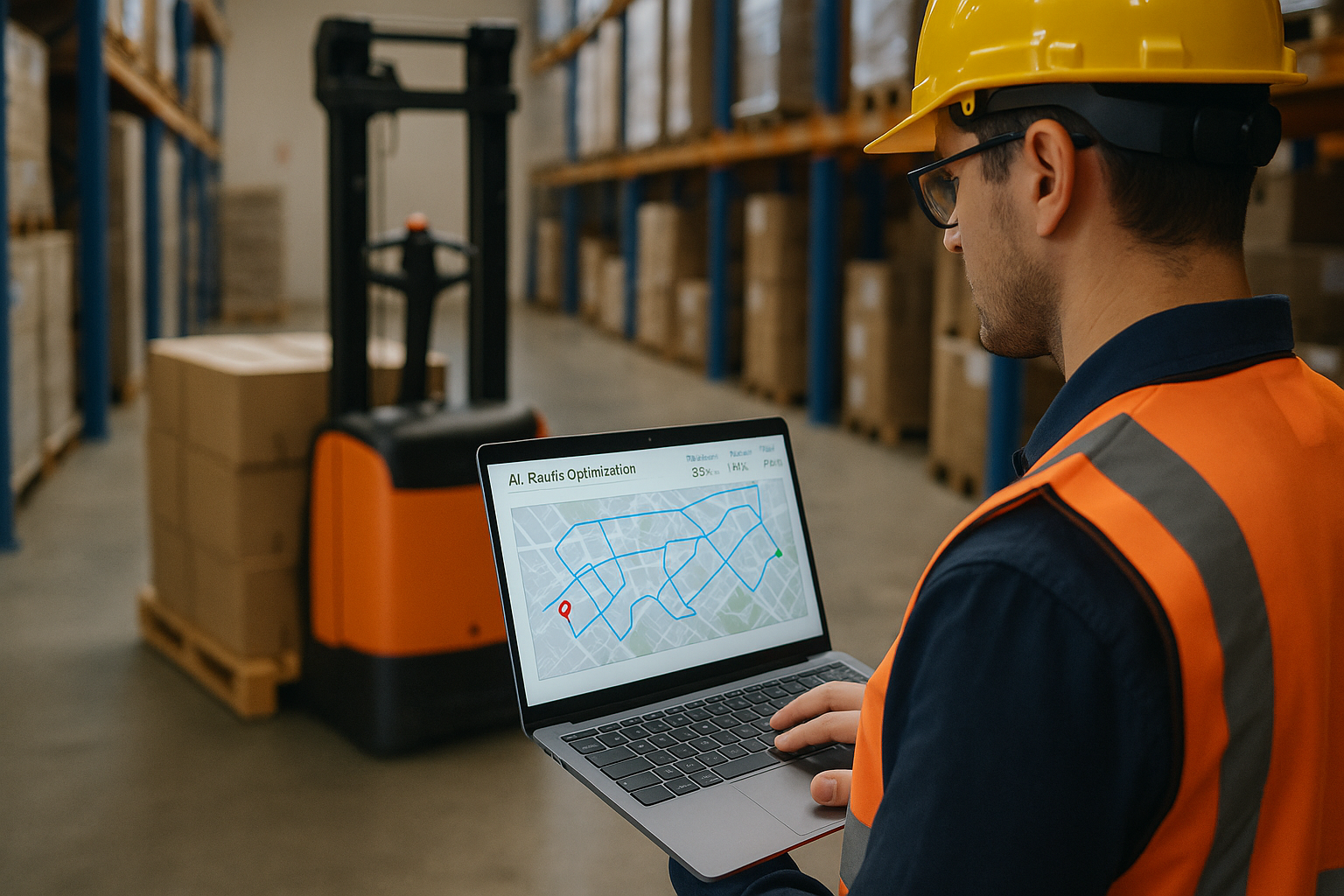
AI route optimization systems function as intelligent traffic controllers for your internal logistics network. They continuously analyze vast amounts of operational data—including current task queues, vehicle locations, facility layouts, historical movement patterns, and real-time constraints—to generate optimal routing decisions that would be impossible for humans to calculate manually.
The technology operates through several interconnected layers. At the foundation, machine learning algorithms study historical data to understand patterns in your facility’s material flow. They identify which routes tend to experience congestion at specific times, which storage locations require frequent access, and how different variables interact to affect travel times.
Real-time optimization engines then use these learned patterns combined with current conditions to make dynamic routing decisions. When a new transport task emerges, the system evaluates all available vehicles, considers their current locations and assignments, calculates multiple potential routes accounting for factors like distance, congestion, and priority levels, then assigns the optimal vehicle-route combination in milliseconds.
Key Technologies Driving AI Route Optimization
Several technological components work together to enable sophisticated route optimization capabilities:
- Machine Learning Algorithms: These continuously improve routing decisions by learning from outcomes, identifying patterns in complex datasets, and adapting to changing operational conditions without explicit reprogramming.
- Digital Twin Modeling: Virtual replicas of your physical facility allow the AI to simulate different routing scenarios, test optimizations before implementation, and predict outcomes with remarkable accuracy.
- Real-Time Location Systems (RTLS): Technologies like RFID, UWB, and BLE provide precise tracking of vehicles, materials, and personnel, feeding critical positioning data into optimization algorithms.
- IoT Sensor Networks: Connected sensors monitor environmental conditions, equipment status, and operational metrics, providing contextual data that refines routing decisions.
- Cloud Computing Infrastructure: Scalable processing power enables complex calculations to occur in real-time, even as facilities grow and operational complexity increases.
📊 Quantifiable Benefits That Matter
The transition to AI-powered route optimization delivers tangible improvements across multiple performance dimensions. Organizations implementing these systems typically observe significant gains within the first few months of deployment.
Travel distance reduction stands as one of the most immediate benefits. By calculating truly optimal routes rather than relying on approximations, AI systems commonly reduce total travel distances by 20-35%. This translates directly into fuel or electricity savings, reduced vehicle wear, and increased capacity to handle additional tasks without expanding your fleet.
Throughput improvements follow closely behind. When vehicles spend less time traveling and more time performing productive transport tasks, your facility can process more materials with the same resources. Many organizations report throughput increases of 15-25% without adding personnel or equipment.
Labor productivity receives a substantial boost as well. Workers spend less time waiting for materials, searching for items, or navigating inefficient routes. The streamlined workflows enabled by AI optimization allow your team to focus on value-adding activities rather than wasting effort on logistical inefficiencies.
Real-World Performance Metrics
Consider these typical results from organizations that have implemented AI route optimization:
- Average reduction in empty travel: 40-50%
- Decrease in congestion incidents: 30-45%
- Improvement in on-time deliveries (internal): 25-35%
- Reduction in energy consumption: 18-28%
- Increase in tasks completed per shift: 20-30%
- ROI timeline: typically 6-14 months
🎯 Strategic Implementation Approaches
Successfully deploying AI route optimization requires more than simply purchasing software. A strategic implementation approach ensures the technology integrates smoothly with your existing operations and delivers maximum value.
Begin with comprehensive baseline measurement. Before implementing any new system, establish clear metrics for your current performance. Document average travel distances, task completion times, vehicle utilization rates, energy consumption, and other relevant KPIs. These baselines become essential for demonstrating ROI and identifying areas where the optimization delivers greatest impact.
Data infrastructure preparation represents another critical foundation. AI systems require high-quality data to function effectively. Audit your current data collection capabilities, identify gaps, and implement necessary sensing technologies before launching the optimization system. Ensure you have reliable position tracking, accurate facility maps, comprehensive task management data, and proper integration points with existing systems.
Phased Rollout Strategy
Rather than attempting a facility-wide implementation immediately, consider a phased approach that minimizes risk while building organizational confidence:
Phase 1 – Proof of Concept: Select a specific zone or operation type for initial deployment. This limited scope allows you to validate the technology, refine configurations, and develop operational procedures without disrupting your entire facility.
Phase 2 – Expansion: Based on lessons learned from the pilot, gradually extend the system to additional areas. Monitor performance continuously and adjust parameters as needed to optimize results for different operational contexts.
Phase 3 – Full Integration: Once the system proves its value and your team develops proficiency, expand to facility-wide deployment. At this stage, you can leverage advanced features like predictive optimization and cross-functional coordination.
⚙️ Overcoming Common Implementation Challenges
While AI route optimization delivers substantial benefits, the implementation journey often encounters predictable obstacles. Understanding these challenges in advance allows you to develop mitigation strategies and maintain momentum.
Change management frequently emerges as the most significant hurdle. Warehouse personnel, forklift operators, and logistics coordinators may feel threatened by automation or skeptical about new technology replacing established practices. Address this proactively through transparent communication about how the system augments rather than replaces human judgment, involving frontline workers in the implementation process, and celebrating early wins that demonstrate clear benefits.
Data quality issues can undermine optimization effectiveness. AI algorithms produce results only as good as the data they consume. Inaccurate facility maps, outdated storage location information, or unreliable position tracking will degrade routing quality. Invest time upfront in data cleansing and validation, establish ongoing data governance processes, and implement quality monitoring to maintain accuracy over time.
Integration complexity with legacy systems represents another common challenge. Your optimization system needs to communicate with warehouse management systems, transportation management platforms, ERP software, and potentially numerous other applications. Plan for technical integration work, allocate sufficient resources for API development and testing, and consider middleware solutions that simplify connections between disparate systems.
🔮 Advanced Capabilities and Future Directions
As AI route optimization technology matures, increasingly sophisticated capabilities are becoming available, enabling even greater operational improvements.
Predictive optimization represents a significant advancement beyond reactive routing. Rather than simply responding to current conditions, these systems forecast future demand patterns, anticipate congestion before it develops, and proactively position resources where they will be needed. This forward-looking approach further reduces response times and improves overall efficiency.
Multi-objective optimization allows the system to balance competing priorities simultaneously. Beyond simply minimizing travel distance, advanced algorithms can optimize for energy efficiency while meeting service level agreements, maximize throughput while respecting safety constraints, or balance workload distribution while minimizing costs. This flexibility enables more nuanced optimization aligned with your specific business objectives.
Autonomous vehicle integration is rapidly evolving from future concept to present reality. AI route optimization systems increasingly coordinate both human-operated and autonomous vehicles within the same facility, managing the hybrid fleet to leverage the strengths of each approach. This capability will become increasingly important as autonomous material handling technologies continue advancing.
Emerging Technologies on the Horizon
Several developing technologies promise to further enhance AI route optimization capabilities:
- Edge Computing: Processing optimization calculations directly on vehicles or local servers reduces latency and enables faster decision-making even if cloud connectivity experiences interruptions.
- 5G Connectivity: Higher bandwidth and lower latency communication networks support more sophisticated real-time coordination and enable richer data exchanges between system components.
- Computer Vision Integration: Cameras equipped with AI-powered image recognition can identify obstacles, assess congestion, and provide additional environmental awareness that refines routing decisions.
- Quantum Computing: While still largely experimental, quantum algorithms may eventually solve extraordinarily complex optimization problems that remain intractable for classical computers.
💼 Building the Business Case
Securing organizational support and budget for AI route optimization requires a compelling business case that clearly articulates costs, benefits, and expected returns.
Quantify potential savings across multiple dimensions. Calculate reduced fuel or electricity costs based on anticipated travel distance reductions. Estimate labor productivity improvements and translate these into capacity gains or potential headcount optimization. Project maintenance savings from reduced vehicle wear. Consider intangible benefits like improved safety, reduced environmental impact, and enhanced ability to meet customer commitments.
Compare implementation costs realistically. Include software licensing or subscription fees, necessary hardware investments like sensors or tracking devices, integration services, training expenses, and ongoing support costs. Many modern solutions operate on subscription models that minimize upfront capital requirements and align costs with realized benefits.
Present multiple scenarios to demonstrate sensitivity to key assumptions. Show conservative, expected, and optimistic outcomes based on different adoption rates, performance improvements, and operational factors. This approach demonstrates analytical rigor while acknowledging inherent uncertainties.
🌟 Success Stories Worth Studying
Examining how other organizations have successfully implemented AI route optimization provides valuable insights and inspiration for your own journey.
A leading automotive parts manufacturer implemented AI routing across their 800,000 square foot distribution center, coordinating 45 forklifts and handling over 12,000 material movements daily. Within six months, they reduced average travel distances by 31%, increased throughput by 22%, and achieved complete ROI. The system paid for itself through reduced energy costs and the ability to defer planned fleet expansion.
A pharmaceutical distributor facing strict temperature-controlled storage requirements and time-sensitive order fulfillment deployed AI optimization to coordinate both material transport and environmental monitoring. The integrated approach reduced emergency transport requests by 67%, improved on-time internal deliveries to 98.5%, and significantly enhanced compliance with regulatory requirements.
A major e-commerce fulfillment center used AI route optimization to coordinate operations during their peak season surge. The system dynamically adapted to 3x normal volumes, coordinating temporary workers alongside experienced personnel, and maintained service levels that would have been impossible with traditional management approaches.
🔧 Practical Steps to Get Started Today
Beginning your AI route optimization journey doesn’t require massive upfront investments or disruptive facility changes. Start with these practical steps that build momentum toward full implementation.
Conduct a logistics audit to identify specific pain points and opportunities. Map current material flows, document bottlenecks, measure key performance metrics, and engage frontline personnel who understand day-to-day operational challenges. This assessment reveals where optimization will deliver greatest impact.
Research available solutions matching your facility size, industry, and specific requirements. The market offers everything from enterprise-grade platforms designed for massive distribution centers to accessible solutions tailored for mid-sized operations. Request demonstrations, speak with reference customers, and evaluate how different options align with your technical infrastructure and operational needs.
Start small with a targeted pilot project. Select a specific area experiencing clear inefficiencies, implement optimization for that limited scope, measure results rigorously, and use demonstrated success to build support for broader deployment. This incremental approach minimizes risk while generating early wins that build organizational momentum.
Invest in your team’s capabilities through training and education. The most sophisticated technology delivers limited value if your personnel lack understanding of how to leverage its capabilities effectively. Provide comprehensive training on system operation, interpretation of optimization recommendations, and data quality maintenance practices that sustain performance over time.
🏆 Maximizing Long-Term Value
Successful AI route optimization implementation doesn’t end with initial deployment. Sustaining and expanding value over time requires ongoing attention and continuous improvement practices.
Establish regular performance reviews that assess system effectiveness against established baselines and identify emerging opportunities. As your facility evolves—adding new product lines, reconfiguring layouts, or adjusting operational processes—ensure your optimization system adapts accordingly. Most modern platforms learn continuously, but periodic human review ensures alignment with strategic objectives.
Foster a culture of data-driven decision making that extends beyond routing optimization. The infrastructure, capabilities, and organizational mindset developed through AI route optimization create foundations for broader operational improvements. Consider expanding into adjacent areas like inventory positioning optimization, labor scheduling, or predictive maintenance.
Stay informed about technology developments and emerging best practices. The AI optimization field continues advancing rapidly, with new capabilities, improved algorithms, and innovative applications emerging regularly. Maintain relationships with technology providers, participate in industry forums, and remain open to adopting enhancements that deliver incremental value.
The revolution in internal logistics powered by AI route optimization represents more than technological advancement—it fundamentally transforms how materials move through facilities, how teams work, and what operational performance becomes possible. Organizations embracing this transformation position themselves competitively for an increasingly demanding business environment where efficiency, speed, and adaptability determine success. The question is no longer whether AI optimization makes sense, but rather how quickly you can implement it to capture available benefits before competitors establish insurmountable advantages.